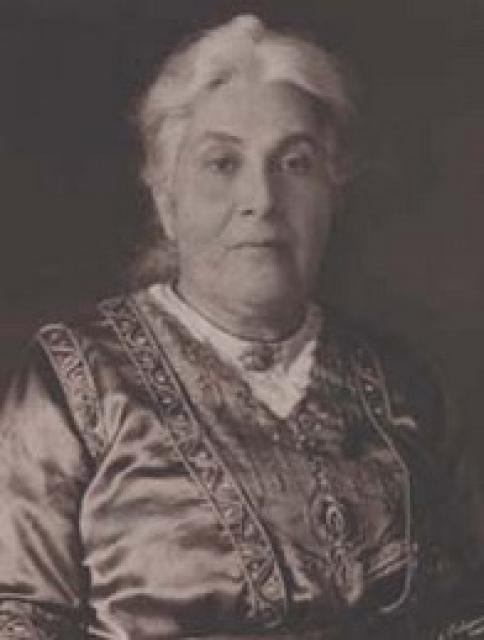
Diana Abgar
 Armenia
Biography of Diana Abgar
Diana Abgar, an Armenian writer, journalist, and diplomat, was born on October 12, 1859, in Rangoon, the capital of British India's colony Burma (now Myanmar). She belonged to the Agabekian family, whose ancestors had emigrated from Jugha (Nakhchivan) to Persia in the late 18th century, and then moved to India. Her father, Ovanes Agabek, was one of the first Armenians to settle in India with his parents when he was a child, while her mother, Avet, came from the Tadeos Avetumyan family, originally from Shiraz. Diana was the youngest of seven children in her family. After her family moved to Calcutta, she was sent to a seminary where she received an English education and learned Sanskrit, while studying Armenian at home.
In June 18, 1889, Diana Abgar married merchant Mikael Abgar (Abgaryan) in Hong Kong. His family had also emigrated from Persia to India. In 1819, one of his ancestors, Arutyun Abgar, founded the "Abgar Trading Company" in Bombay, which later moved to Calcutta. The company was engaged in importing and exporting rice to Singapore and Punjab. After their marriage, the young couple settled in Kobe, a port city in Japan, on the coast of the Pacific Ocean. They established a company involved in import and export trade and opened the "Great East Hotel." It was in Japan that Diana Abgar discovered her talent for writing novels. Her first novel, "Susan," was published in 1882, followed by "Tales from the Homeland," which depicted the life of the Japanese people. They had five children in Japan, two of whom died at a young age.
After the sudden death of her husband in 1906, Diana continued her literary activities and took over the management of the company until her son came of age. After some time, she and her children moved to Yokohama, the busiest port city in Japan, located 30 kilometers from Tokyo. They opened a large trading house that conducted business with China, the United States, and Europe. During the eve of the First World War and throughout the war, Diana Abgar gave lectures about the Armenian people, wrote articles, and collaborated with the English-language newspaper "Japan Gazette" and "Far East." She was one of the first to convincingly show that the Adana massacre was organized and carried out by the constitutional government. Her goal was to raise global awareness, emphasizing the moral obligation of the West to save the Armenian nation, and she wrote about the unbearable conditions of Armenians in the Ottoman Empire. In the second decade of the 20th century, with the help of the "Japan Gazette" publishing house, eight more novels by Diana Abgar were published in English, including "The Truth About the Armenian Massacres" (1910), "The Armenian Question," "Armenia Betrayed" (1910), "In Her Name" (1911), "The World in Europe," "The Problem of Peace" (1912), "The World and Not the World" (1912), and "Great Evil" (1914). These works received high praise from the American media. She also published several articles, including notable ones such as "The Terrible Curse," "The Stupidity of Imperial Europe," and "Crucified Armenia." Diana Abgar corresponded with many political and spiritual figures around the world. She was the only Armenian woman who had a comprehensive understanding of international affairs. In addition to these works, she published the novel "The Lonely Crusader," the work "Imperialism and Law," pamphlets and articles in academic, political, and trade publications, as well as poetry in European and American press. Her last collection was titled "From the Book of a Thousand and One Stories: Tales of Armenia and Its People, 1892-1922."
Being familiar with British colonial activities in India, Abgar accurately anticipated the lack of European assistance to Armenians living in the Ottoman Empire. She wanted the United States to become Armenia's protector, but that never happened. As a patriot of her people, she tried to be useful to her compatriots and Armenia, despite never having visited her historical homeland. Diana Abgar actively helped numerous Armenian refugees who tried to migrate to the United States through Siberia and Japan. In Vladivostok, after the Armenian genocide, around 500 Armenians had gathered, most of whom were transported to America with the help of the Armenian benefactor. Thanks to the efforts of Diana Abgar, Japan became the first country to officially recognize the independence of the First Republic of Armenia in 1920. Due to her skilled actions and extensive work, on July 21, 1920, Diana Abgar was appointed as the diplomatic representative and Consul General of the First Republic of Armenia in the Far East. In a letter dated July 22 of the same year, signed by the Minister of Foreign Affairs of the Republic, Amo Ohanjanyan, the appointment was accompanied by a note stating, "to protect the interests of our newly born homeland and alleviate the conditions of our compatriots." Thus, she became the first woman in the world to hold a diplomatic position. Her new status provided her with more opportunities in the high circles of the Japanese government, which significantly facilitated her work on behalf of Armenian refugees.
In her efforts to help her historical homeland and its people, she actively engaged in various activities while corresponding with several politicians and human rights activists. Among those with whom she maintained regular correspondence were American President Woodrow Wilson, Secretary Robert Lansing, Deputy Secretary Ulysses Grant-Smith, President of the Humanitarian Organization James L. Barton, members of the International Congress of Peace Arthur Simonds and David Starr Jordan, as well as other prominent individuals. Abgar was a devout woman, reading the Bible and singing church hymns. In 1920, she wrote a letter to the head of the Armenian Apostolic Church in the United States, expressing her desire to enter the church again, stating that she had not found any other church with the same dynamic spirit as the Armenian Church and the same prayers that soothed her soul and elevated her spirit. She remained a follower of the Armenian Apostolic Church throughout her life and maintained a connection with Etchmiadzin. Diana Abgar passed away on July 8, 1937, in Yokohama and was buried in the foreigner's cemetery there, next to her husband. Currently, her grave is under the patronage of the Armenian-Japanese Friendship Society in Tokyo.
In 1938, her sons emigrated to the United States, taking with them all of their mother's letters and manuscripts. In honor of the 150th anniversary of Diana Abgar's birth in December 2008, a literary evening was held in Boston, during which a collection of Diana Abgar's stories in English, titled "A Thousand Stories," was presented by her granddaughter Lucille Abgar. On February 19, 2008, a 20-minute film by Armenian director Mariam Oganyan titled "Women and Politics" was presented at the Yerevan Film Festival, which included a segment about Diana Abgar.