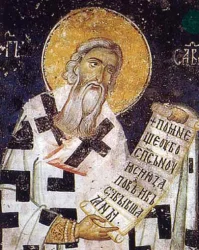
Dionysius Exiguus
Dionysius Exiguus was a sixth-century monk and scholar whose work gave the Western world a new way to number years. Around 525, while preparing tables for calculating Easter, he reckoned years from the incarnation of Christ rather than continuing an earlier count based on the reign of the Roman emperor Diocletian. His Anno Domini system took centuries to spread, but it ultimately became the basis for the year numbering used in much of the world today.
A Monk from Scythia
The details of Dionysius’s early life are sparse. He was from Scythia, probably the Roman province of Scythia Minor along the western Black Sea, and later lived and worked in Rome. The Latin word exiguus means “small” or “humble”; it is often understood as a modest self-description rather than a comment about his height. His writing shows a scholar at home in both Greek and Latin, with a strong interest in the theological debates and church records of his time.
Dionysius was part of a community of monks and church officials who helped translate and organize Christian texts. He rendered Greek theological works into Latin and compiled collections of church canons and papal letters. These efforts helped make decisions from earlier councils available to Latin-speaking church authorities and preserved writings that might otherwise have been harder to consult.
Easter Tables and a New Era
One of the most important questions for the early church was how to calculate the date of Easter. Around 525, Dionysius was asked to prepare a new table of Easter dates. Earlier tables counted years using the era of Diocletian, the Roman emperor associated with severe persecution of Christians. Dionysius instead labeled the years according to the incarnation of Jesus, using the Latin phrase Anno Domini, meaning “in the year of the Lord.”
His work was a practical calendar project, not the launch of a world standard. The system did not become common across Europe during his own lifetime. Centuries later, the English monk Bede used the Anno Domini reckoning systematically in his historical writing, helping it gain broader acceptance. From there, the convention spread through chronicles, official records, and eventually civil calendars.
Dionysius’s calculation of the year associated with Jesus’s birth was not exact by modern historical estimates; many scholars place the birth several years earlier. The system also had no year zero: the sequence moves directly from 1 BC to AD 1. That gap reflects the numbering conventions available in the Latin West at the time, and it can make calculations across the eras less intuitive.
A Scholar’s Legacy
Dionysius’s importance reaches beyond calendar arithmetic. His translations and collections contributed to the organization of canon law and the transmission of early Christian literature. Yet his name became most widely known through a system that was initially only one component of a table for church feasts.
The era he introduced eventually outgrew its original ecclesiastical purpose. Today, even people who do not use Christian religious language often encounter the Anno Domini framework or its secular counterpart, the Common Era. Dionysius did not live to see that worldwide influence. Working as a careful monk and compiler in Rome, he made a technical choice for a church calendar that, over time, reshaped how generations recorded history.