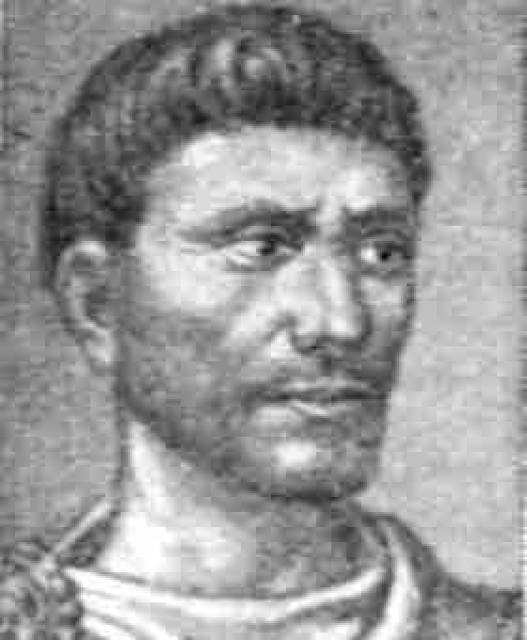
Diophantus Alexandria
 Greece
- Diophantus of Alexandria: The Father of Algebra
- The Enigma of the Epigram
- Arithmetica: Groundbreaking Mathematical Treatise
- Mathematical Notations and Algebraic Concepts
- Focus on Indeterminate Equations
- Legacy and Influence
- Rediscovery of Fragments
- Other Mathematical Contributions
- Lunar Recognition
Diophantus of Alexandria: The Father of Algebra
Early Life and InfluencesDiophantus of Alexandria was an ancient Greek mathematician who lived during the 3rd century CE. Little is known about his personal life. He quoted Hypsikles (2nd century BCE) and was referenced by Theon of Alexandria (c. 350 CE), indicating that he lived within that time frame. It is possible that he dedicated his work, "Arithmetica," to the venerable Bishop Dionysius of Alexandria, who lived in the mid-3rd century CE.
The Enigma of the Epigram
A mathematical enigma from the Palatine Anthology suggests that Diophantus lived for 84 years. It reads:
"Here lies Diophantus. The god revealed to him his life in a puzzle: his childhood lasted for a sixth of his life, his youth for a twelfth, and his unmarried life for a seventh. He was married for five years, and it was after five years that his son was born. The beloved child lived half of his father's married life. After his son's untimely death, Diophantus lived for four years."
Arithmetica: Groundbreaking Mathematical Treatise
Diophantus's most significant work, "Arithmetica," was a 13-volume treatise on indeterminate analysis and number theory. Although only six books have survived, they revolutionized mathematics.
Mathematical Notations and Algebraic Concepts
Diophantus introduced a systematic system of algebraic notation, using letters to represent unknowns and powers. He developed rules for combining like terms and adding or subtracting numbers and expressions from both sides of an equation, a concept later known as "al-jabr" by al-Khwarizmi. Diophantus also formulated the rule of signs, which states that multiplying two negative terms produces a positive term.
Focus on Indeterminate Equations
A significant contribution of Diophantus was his focus on indeterminate equations, equations with an infinite number of solutions. He explored various methods for finding positive rational solutions to these equations, including systems of equations and methods for deriving multiple solutions from a known solution.
Legacy and Influence
Diophantus's work was translated into Arabic in the 10th century, where it influenced Muslim mathematicians such as Abu Kamil. In Europe, his "Arithmetica" was rediscovered in the 16th century and became instrumental in the development of modern algebra. Mathematicians such as François Viète and Pierre Fermat were heavily influenced by Diophantus's methods.
Rediscovery of Fragments
In the 20th century, four additional books of Diophantus's "Arithmetica" were discovered in an Arabic text. Scholars speculate that these books may not have been written by Diophantus himself but by a commentator who was well-versed in his methods.
Other Mathematical Contributions
Besides his work on indeterminate equations, Diophantus also wrote treatises on polygonal numbers ("De Multangulis Numeris") and measurements ("De Mensurationibus"). Fragments of a work on multiplication ("De Multiplicibus") have also survived.
Lunar Recognition
In honor of Diophantus's mathematical contributions, a crater on the Moon has been named after him.