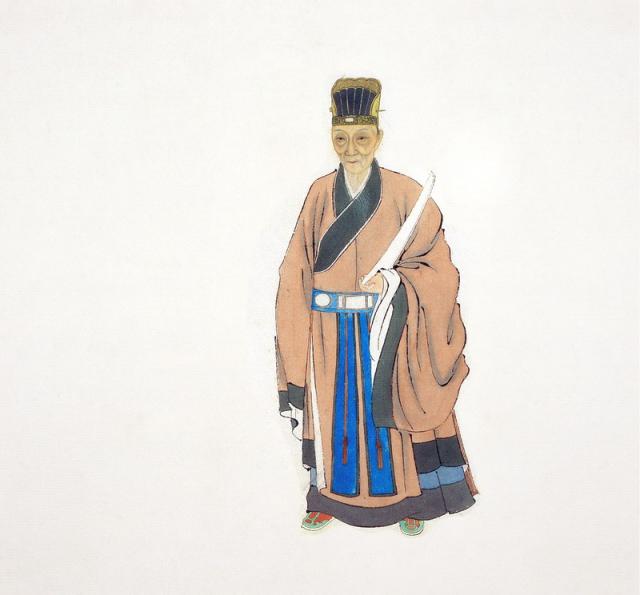
Dong Qichang
 China
China- Early Life and Education
- Imperial Court Service and Calligraphic Renown
- Imperial Appointment and Political Intrigues
- Personal Excesses and Controversies
- Later Years and Legacy
Early Life and Education
Dong Qichang, a prominent Chinese artist, theorist, calligrapher, and collector, was born into a poor yet educated family in Huating (now known as Songjiang, a district of Shanghai). Displaying exceptional abilities from a young age, he passed the civil service examination at the age of 12, earning the title of "government student" (shengyuan) and securing a coveted spot at the prefectural school.
Imperial Court Service and Calligraphic Renown
At 17, Dong passed the imperial service examination but placed second, largely due to his poor performance in calligraphy. From that point on, calligraphy became his particular focus, with him tirelessly practicing and eventually gaining renown among connoisseurs of the art. He meticulously studied the styles of renowned ancient masters from Zhong Yao (151-230 AD) and Wang Xizhi (306-361 AD) to Yu Shinan (558-638 AD) and Yan Zhenqing (709-785 AD), dedicating years to the pursuit.
Imperial Appointment and Political Intrigues
In 1589, Dong was appointed to the imperial court, holding the prestigious position of tutor. The following year, he traveled to Beijing and became a member of the Imperial Academy, tutoring the son of Emperor Wanli (1572-1620). However, the late 16th and early 17th centuries witnessed the decline of Ming imperial power and intensified social conflict and factional struggles within the ruling elite. As the top official in charge of imperial family affairs, Dong was not immune to the political turmoil of his time; in 1599, he became embroiled in a conspiracy but feigned illness to avoid repercussions, retreating from the court for several years.
Personal Excesses and Controversies
During this period, Dong's fame soared, with governors and wealthy individuals vying for his calligraphy. However, his character deteriorated, and historical accounts suggest that he succumbed to the temptations of fame and power, becoming arrogant, pretentious, and licentious. In 1604, he returned to the Academy but behaved in such a way that students revolted against him; although he was eventually cleared of wrongdoing, he was forced to resign.
In 1615, an even more outrageous incident occurred. Dong forcibly took a farmer's daughter as his concubine. The story, with some embellishments, became public knowledge. Dong, suspecting that a certain Fan Chang had fabricated the tale, ordered his torture and eventual execution. Fan's wife, who came to Dong with a complaint, was insulted and beaten by his servants. Her petition to the government was dismissed, likely under Dong's influence. Enraged, a mob ransacked and burned his residence.
Later Years and Legacy
After an extended period of retirement from 1605, Dong was invited back to government service in 1622 by his former student, Emperor Tianqi (1620-1627), this time to compile the history of the Ming dynasty. However, political intrigue once again forced him out of office. In 1631, he traveled to Beijing once more, serving as tutor to the crown prince for Emperor Chongzhen (1627-1644). He retired after three years and devoted himself exclusively to the arts until his death in 1636.
Among Dong's closest associates were the scholar-artists Mo Shilong (1537-1587) and Chen Jiru (1558-1639), who were roughly his contemporaries. This trio formed the core of the so-called "Huating School" of painting. They had been friends since their youth and maintained their camaraderie despite the different paths their careers took. United by shared interests, they frequently gathered to discuss ancient books and paintings. Their discussions fueled each other's inspiration and led to the theories Dong developed and expounded in his "Hua Zhi" (Essence of Painting).
In addition to this renowned treatise, Dong Qichang also authored two other important works: "Hua Yan" (Eye of Painting) and "Hua Chanshi Suibi" (Notes from the Studio of Painting and Meditation). The latter is a wide-ranging work that encompasses not only painting and calligraphy but also poetry and Chan philosophy.