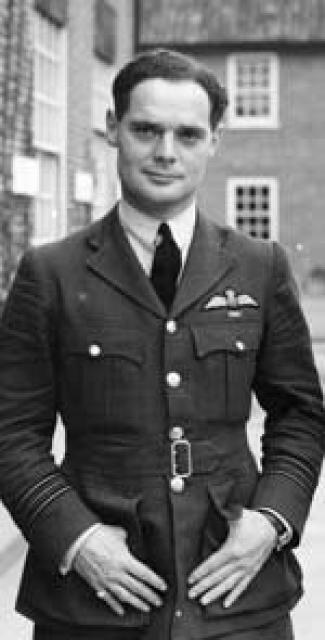
Douglas Bader
 Great Britain
- Biography of Douglas Bader
- Early Life
- Accident and Recovery
- World War II and Aviation Achievements
- Life after the War
Biography of Douglas Bader
Douglas Robert Steuart Bader was a British World War II flying ace and a colonel in the Royal Air Force (RAF). He achieved 20 personal victories and damaged 11 enemy aircraft. His story is sometimes compared to that of Soviet pilot Alexey Maresyev, as both Bader and Maresyev lost both of their legs.
Early Life
Douglas Robert Steuart Bader was born in 1910 in St John's Wood, London. He was the second son of engineer Frederick Roberts Bader and his wife Jessie. During his childhood, he lived in India for a while, where his father worked. The family later moved back to London, where Douglas completed his schooling.
Bader joined the RAF in 1928 and began flying in 1930. During his time in school, he played rugby and cricket, and excelled in aviation theory and practice.
Accident and Recovery
In December 1931, while flying at low altitude during training flights, Bader crashed his plane into the ground. The consequences were grim - both of Bader's legs were amputated. It seemed that his promising flying career was over. However, Bader refused to give up and began training again after recovering from the operation. Unfortunately, his superiors had a different opinion about his future, and Bader was discharged from the military. Undeterred, he fought to rejoin the RAF and managed to do so just before the start of World War II. He was even allowed to fly again. Thus began his illustrious military career, and soon legends circulated about him.
World War II and Aviation Achievements
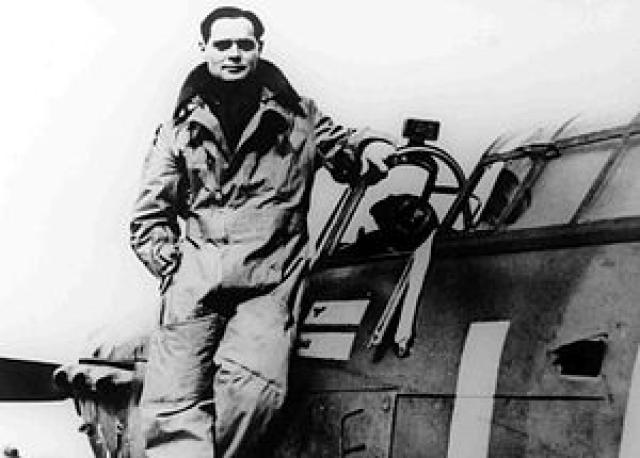
Bader served as the commander of a fighter wing. In 1940, he flew in the Battle of France and later fought in the Battle of Britain. It was during the Battle of France that he achieved his first victory in an aerial combat. Bader gained a reputation for being "the man with no nerves" - he displayed an incredible fearlessness and sometimes even mocked the deadly danger he faced. Whether it was a form of protection or if Bader truly lost his fear after his initial crash remains unknown. However, those who fought alongside Bader recalled that he approached the most challenging missions as if going on a picnic - calmly entering the cockpit of his plane with his mandatory pipe in hand, completely serene and composed, while other pilots struggled to gather their nerves, encouraged each other, and tried to hide their fear. Bader also became known for his ridiculous habit of smoking his pipe in the cockpit on his way home. These details contributed to the myths surrounding the invincibility of the legless pilot.
Although he was a strict and sometimes sarcastic commander, Bader commanded the respect and discipline of his subordinates. He achieved 20 personal victories and damaged 11 enemy aircraft throughout his career.
Life after the War
Bader's plane was shot down over France in August 1941, most likely due to friendly fire. At that time, France was occupied by the Germans, and Bader became a prisoner of war in the infamous Colditz Castle. He was only freed in April 1945 when the American troops arrived. It is worth noting that there is a story about how the authorities managed to deliver new prosthetics to Bader, as his old ones were lost when his plane was shot down.
He remained in the RAF until 1946, after which he resigned and began working in the oil business. In the 1950s, a book titled "Reach for the Sky" by Paul Brickhill was published, describing Bader's service in the RAF and his combat biography. The book became a bestseller, although Bader himself was not particularly pleased with it.
Bader continued to fly throughout his life until the late 1970s. In 1976, he was knighted for his military services and his work in assisting disabled individuals. Sir Douglas Bader passed away from a heart attack on September 5, 1982, at the age of 72.
In terms of his personal life, it is known that his first wife, Thelma, passed away in 1971 due to throat cancer, as she was a heavy smoker. A couple of years later, in 1973, Bader remarried Joan Murray, and they spent the rest of their lives together in Marlston, Berkshire.


