
Ivan Belozerov
 Ukraine
Biography of Ivan Belozyorov
Ivan Pavlovich Belozyorov, a senior lieutenant and fighter pilot of the Guards, accomplished 300 successful combat sorties, participated in 34 aerial battles, personally shot down 8 enemy planes and 18 more in a group with his comrades, and destroyed numerous enemy military targets. On May 16, 1944, for his courage and bravery displayed in battles against the enemy, he was awarded the title of Hero of the Soviet Union.
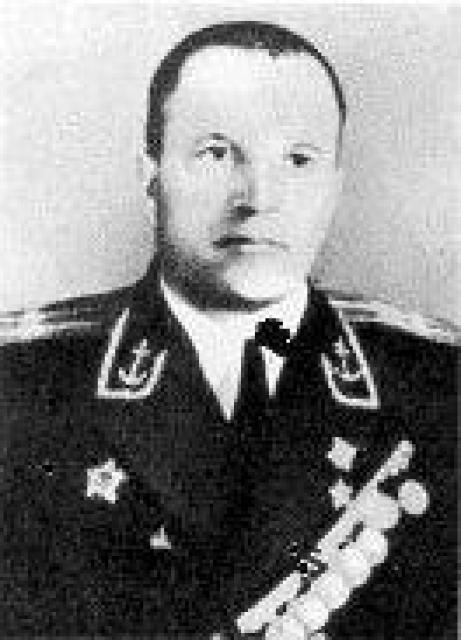
Ivan Belozyorov was born on September 1, 1918, in the village of Malye Prokhody, now part of the Dergachevsky district of the Kharkov region, in a peasant family. He completed an incomplete secondary school and a factory technical school in Kharkov. He then worked as a lathe operator at a locomotive building plant and later became an instructor at an aeroclub. He joined the Red Army in 1939 and graduated from the Chuguev Military Aviation School in 1940. He served on the front lines of the Great Patriotic War from the very beginning. He began his combat activities as part of the 8th Fighter Aviation Regiment of the Black Sea Fleet Air Force. By April 1944, he became the commander of a squadron in the 6th Guards Fighter Aviation Regiment (11th Assault Aviation Division, Black Sea Fleet Air Force).

In total, Guards Senior Lieutenant Ivan P. Belozyorov completed 460 successful combat sorties. He was awarded the Orders of Lenin, Bogdan Khmelnitsky, Red Banner (twice), the Patriotic War 1st and 2nd Class, and the Red Star (twice), as well as various medals.
After the war, he continued to serve in the Air Force. In 1945, he graduated from the Senior Officer Courses of the Navy Air Force. Since 1964, Lieutenant Colonel Ivan P. Belozyorov served in the reserve. He lived in the city of Simferopol and worked as a senior dispatcher at a civil aviation enterprise. Throughout this time, he was an active member of the Railway Veterans Council and contributed greatly to the strengthening and unity of veteran organizations in Crimea. He was awarded Honorary Diplomas of the Presidium of the Supreme Council of the Autonomous Republic of Crimea in 1999 and 2005 for his diligent work. His name is engraved on the memorial to aviators - Black Sea sailors in Sevastopol. He authored the book "In the Skies of Tavria." He passed away on February 14, 2006.
"Sevastopol, I am here again, on the sacred land of Chersonesus"
In May 1944, a burnt wreckage of an enemy torpedo boat lay crookedly on the stones of Chersonesus. A short and slender man in the uniform of a naval aviator approached the edge of the shore and kicked the scattered debris with his foot.
"Sevastopol, I am here again, on the sacred land of Chersonesus. But now I will have to fly far to the West to avenge you, my dear city," he murmured.
"No fascist should leave Sevastopol alive!" It was not just an order from the command, but a command from his own heart. The main task of the fighters was to cover torpedo bombers, torpedo boats, and dive bombers that were striking blow after blow on the enemy's gathering points, sinking enemy ships and transports. But our fighters always found other work for themselves.
Early in the morning, while patrolling in a Yak-9 aircraft over the Chersonesus area, Ivan Pavlovich Belozyorov noticed two large torpedo boats filled with retreating Germans and decided to destroy them. He made his first approach from the direction of the rising sun. From a low altitude, he fired his machine guns and cannons at the boat and saw a column of fire rise above it. The burning ship rushed towards the coastal rocks. He made a turn and attacked again, but the second boat was already ready for battle. Maneuvering and firing back, it retreated under the cover of its coastal anti-aircraft batteries.
It was time to return to the airfield, replenish fuel and ammunition, rest for a while, and then go back into battle.
Ivan Belozyorov often flew alongside his comrades in search of the enemy, fearlessly confronting German aces and almost always emerging victorious from intense aerial battles. Day and night, in any weather, they took to the skies, humble war workers, masters of their craft, studying the enemy's communication lines, uncovering hidden enemy forces and equipment cleverly camouflaged. They often directed the strike groups to the discovered targets themselves.
Ivan Belozyorov flew many reconnaissance missions and always found the most reasonable solution when determining the flight route and the direction of approach to the enemy target. This foresight helped him gather valuable intelligence about the enemy and avoid encounters with enemy fighters.
Once, Belozyorov was returning from another combat mission. He managed to spot a concentration of German troops. It was crucial to not only report this information but also indicate the precise approaches to the target and the most likely points of attack.
Above the front line, his aircraft came under attack by two German fighters. The enemy tried to eliminate the lone Soviet scout. Belozyorov bravely engaged in an unequal battle. Seeing that one of the Messerschmitts was getting behind him, Ivan quickly changed the direction of his flight and fired at the Me-109 from his machine guns. The Messerschmitt wobbled and spiraled into a dive, never to recover. Soon, a column of fire and smoke rose from below... The surviving pilot of the deceased German did not dare to test his fate and hurriedly left the battle.
Flying became increasingly difficult. The Germans had installed heavy artillery not far away and periodically shelled the airfield. They especially intensified their attacks during takeoff. It was not difficult to determine the moment when an airplane started its engine; huge clouds of reddish Chersonesus dust would rise above the airfield.
The ground specialists outwitted the enemy. They tied large bundles of branches to their vehicles and raced at full speed along the runway. Almost immediately, heavy shells would start exploding. Once the German battery had fired its allotted time, it fell silent, and the fighters took advantage of this lull to take off and carry out their next mission.
In aerial battles over Sevastopol during its heroic defense, Ivan Belozyorov shot down, as he jokingly put it, "five and a half" German airplanes: five personally and one in tandem with his wingman.
During those days, Lieutenant Ivan P. Belozyorov commanded a reconnaissance unit. Improvised homemade cameras were installed on the fighters. A clever mechanism connected the camera to a button. The pilot pressed it, a photo was taken, and the film automatically rewound. Belozyorov had to fly on aerial reconnaissance missions with such a camera attached to his aircraft. These assignments were given to the most daring and skilled pilots. He had to fly along the front line, and the Germans had an abundance of antiaircraft guns at that time.
One day, a group of Crimean partisans came to Chersonesus. They talked about the difficult situation and asked for help. It was decided to establish communication with them and drop an experienced radio operator into the forest. But who and on what aircraft should fly to this inaccessible area? The choice fell on three pilots: I. Belozyorov, F. Gerasimov, and V. Klyukov.
A detailed plan for the operation was developed, and every detail was carefully thought out. Lieutenant Gerasimov would transport the radio operator on a Po-2 aircraft, while Belozyorov and Klyukov would provide cover on their fighters. Near Balaklava, there was a dense wall of fire. German fighters were attempting to destroy the unusual trio, but they failed. The mission was executed excellently! However, Gerasimov's aircraft was damaged during the landing, and the pilot had to make his way to Sevastopol through partisan trails. For this feat, F. Gerasimov was awarded the title of Hero of the Soviet Union, and Ivan Belozyorov received an order.
Ivan Belozyorov vividly remembers his first flight over Sevastopol in 1944. The smoking ruins, the empty shells of destroyed houses, and the bays cluttered with the wreckage of sunken ships.
"Can one ever forgive those who destroyed you, Sevastopol?" he thought at that time. "Can one let even one enemy escape unpunished from here? But you will rise again from the ruins, beloved city. And believe me, I will avenge these ruins."
Naval aviator Ivan P. Belozyorov kept his word. During those days, he flew on an aircraft with the number "26" on its side. One day, near Sevastopol, Belozyorov escorted a group of bombers that were operating in the open sea, destroying enemy transports fleeing from Crimea. A large group of German fighters attacked our aircraft. The completion of this important mission was under threat. Belozyorov engaged in battle. In the very first attack, his aircraft was hit by enemy machine-gun fire. The pilot was wounded but continued to fight, shot down 2 enemy planes, and only left the battle when he was convinced that the threat to the bombers had passed.
The never-ending Black Sea wave murmurs about its own thoughts, moving between the stones of Chersonesus. It reaches the spot where the burnt wreckage of a German torpedo boat lay many years ago, stops as if remembering something, and slowly rolls back.
Not far from the stones stands a man in the uniform of a civil aviation pilot, with the Golden Star of a Hero on his chest. The man has a young face and gray temples. He smiles, and mischievous sparks dance in his cheerful eyes.
"I am once again your guest, my Chersonesus, my Sevastopol. Bloom and prosper, beloved city. Grow younger with each passing year. And don't look at my gray temples with reproach, I have no intention of aging either - we still have a lot to do together!"


