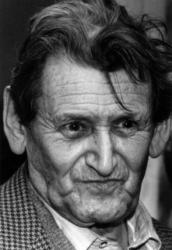
Dovid Seltser
 USA
USA- Biography of David Selzer
- Journey to New York
- Literary Career
- Collaboration with Artists
- Musical Adaptations
- Legacy
Biography of David Selzer
David (Duvid) Selzer was an American Jewish poet, writer, and publicist who wrote in Yiddish. He was born in 1904 in Soroca, a town in the Bessarabian Governorate of the Russian Empire (now Soroca district, Moldova). Selzer received a traditional Jewish religious education in his hometown.
Journey to New York
In 1920, Selzer emigrated to the United States and settled in New York City. He attended the Jewish Workers' University, graduating in 1928. During this time, Selzer worked as a director of workers' clubs in the city and began writing poetry in Yiddish.
Literary Career
Selzer made his literary debut in the New York-based communist newspaper "Morgen-frayhayt" (Morning Freedom) in 1931. He subsequently published in various leftist Jewish periodicals, including "Frayhayt" (Freedom), "Dэр hамэр" (The Hammer), and "Signal." In 1936, he became the editor of the journal "Funken" (Sparks) and later edited other periodicals in New York City.
Selzer's writing encompassed poetry, prose, and memoir. His first collection of poems, "Besaraber Lider" (Bessarabian Poems), was published in 1937 with illustrations by renowned New York graphic artist Zuni Maud. Subsequent poetry collections, such as "Bronzviller Gezzang" (Brownsville Ballad, 1942) and "Di Oysgebentke Sho" (The Suffering Hour, 1947), featured woodcuts by American engraver Helen West Heller. In 1961, Selzer published a memoir entitled "Bilder un Geshtaltn Fun Soroke" (Pictures and Images of Soroca), followed by a volume of selected poetry, "Gezangen Far Sholem un Freyd" (Songs for Peace and Joy) in 1964.
Collaboration with Artists
Selzer collaborated closely with illustrators and artists throughout his career. His works were accompanied by the artistic contributions of Zuni Maud, Helen West Heller, and others.
Musical Adaptations
Some of Selzer's poems were set to music by composer Mark Olp and are still performed by klezmer bands today. A collection of these songs, "Ten Modern Songs From Moldavia," was released by the Jewish Music Alliance in 1972.
Legacy
David Selzer's contributions to Yiddish literature earned him recognition as a significant figure in the field. His writings have been praised for their lyrical beauty, evocative language, and reflections on the Jewish experience. Selzer's legacy continues to inspire Yiddish writers and scholars worldwide.