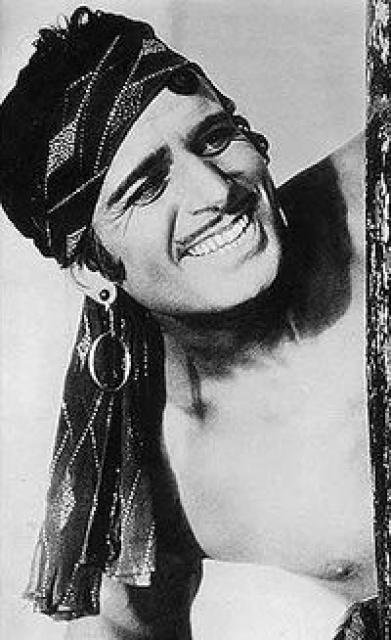
Duglas Ferbenks
 USA
USA- Douglas Fairbanks - An American Movie Star
- Early Career
- Breakthrough and Success
- Founder of United Artists
- Later Career and Legacy
Douglas Fairbanks - An American Movie Star
Douglas Fairbanks was an American actor and one of the biggest stars of the silent film era. He was born into a successful businessman and lawyer family. From a young age, he participated in horseback riding, fencing, athletics, and had a passion for theater. After finishing school, he enrolled at Harvard University, but soon informed his father that he wanted to become an actor. He was cut off from financial support and used his own savings to travel to Europe.
Early Career
In Europe, Fairbanks worked as a digger in the construction of the Paris Metro, then as a porter in the London port, and later became a sailor on a cargo ship. In 1900, he returned to America on the same ship and worked as a salesman in a hardware store and a clerk on Wall Street while trying to establish himself in the theater. In 1902, he made a successful debut as a stage actor on Broadway, adopting the pseudonym "Douglas Fairbanks". In 1907, he married Anna Beth Sully, the heiress of a major business, and temporarily left the stage.
Breakthrough and Success
In 1909, Fairbanks' wife's company went bankrupt, and he returned to acting. By 1912, he had achieved considerable recognition. In 1915, he was invited to act in films by the Triangle Pictures studio, alongside other theater actors. His first film, "The Lamb" (1915), directed by William Christy Cabanne and written by D.W. Griffith, was well-received, establishing Fairbanks as a leading actor in romantic comedies. A series of films directed by John Emerson and written by Anita Loos were created specifically for Fairbanks, combining his charm with his ironic approach to his characters. One of the most famous films of this period was "The Americano" (1916), in which Fairbanks, as described by Georges Sadoul, "quells an armed rebellion in South America with his inherent cheerfulness."
Founder of United Artists
In February 1917, Fairbanks left Triangle and founded his own company, the Douglas Fairbanks Film Corporation, under the umbrella of Paramount Pictures. In 1919, he divorced his first wife and soon married actress Mary Pickford. In the same year, Fairbanks, Pickford, Charlie Chaplin, and D.W. Griffith founded United Artists, which allowed them creative freedom and control over the distribution of their films. They also helped establish the Motion Picture Fund in 1921, which continues to provide assistance to individuals in the film industry who are in need.
Later Career and Legacy
In 1920, Fairbanks released one of his most famous films, "The Mark of Zorro," which furthered his popularity and paved the way for a series of costume historical action films such as "The Three Musketeers" (1921), "Robin Hood" (1922), "The Thief of Bagdad" (1924), "The Black Pirate" (1926), and others. Fairbanks and Pickford were the first film industry figures to leave their handprints in wet cement on the Hollywood Walk of Fame during the opening ceremony of Grauman's Chinese Theatre on April 30, 1927. In the same year, Fairbanks became the first president of the Academy of Motion Picture Arts and Sciences and hosted the first Academy Awards ceremony.
Fairbanks' last silent film was "The Iron Mask" (1929), and he made his first sound film, "The Taming of the Shrew" (1929), with Pickford. However, the film did not achieve the expected success, and Fairbanks gradually withdrew from the industry. His final film was "The Private Life of Don Juan" (1934). In 1933, he began a romance with Sylvia Ashley. In 1936, he divorced Mary Pickford and married Ashley, with whom he settled in Santa Monica.
Douglas Fairbanks passed away on December 12, 1939, from a heart attack. He frequently wrote screenplays for his films, using the pseudonym "Elton Thomas" in the credits. Fairbanks has been portrayed in several films about the history of cinema, such as "Chaplin" (1992), where he was portrayed by Kevin Kline.


