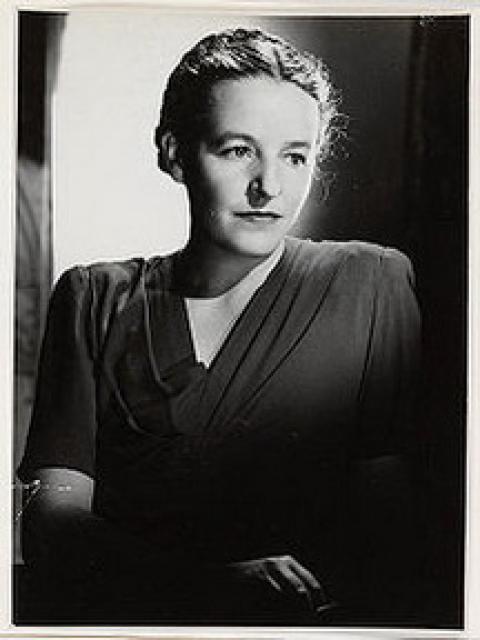
Dymphna Cusack
 Australia
- Early Life and Education
- Teaching Career
- Early Writing
- Breakthrough with "Jungfrau"
- Personal Struggles and Resilience
- Later Works and Legacy
Early Life and Education
Dymphna Cusack was born on September 22, 1902, in Wyalong, New South Wales, Australia. Her father was a sheep farmer, and her mother was the daughter of an Irish rebel who had immigrated to Australia in the mid-19th century. Dymphna's grandfather instilled in her a "rebellious spirit," a love of freedom, and an intolerance of violence and oppression.
She attended St. Ursula's Catholic school in Armidale, where she was taught under the strict supervision of nuns. The regime was harsh and instilled in the students principles of honesty, morality, compassion, and a love for one's neighbor.
In 1926, Dymphna graduated from the University of Sydney with a degree in literature, history, and philosophy. There, she developed a strong sense of national identity and an interest in Australian culture and history.
Teaching Career
After graduating from university, Dymphna worked as a teacher in New South Wales for about 20 years. It was during this time that she gained firsthand knowledge of the lives of people in industrial areas, witnessing the poverty and crime that resulted from economic hardship.
Early Writing
The early 1930s was a turbulent period in Australia, marked by political and social upheaval. Dymphna Cusack became involved in the anti-fascist movement and the campaign to defend Spain. She felt a deep connection to the events happening around the world.
Her early writings, such as the psychological drama "Comets Blaze Fast" (1943), reflected the social and political issues of the time.
Breakthrough with "Jungfrau"
Dymphna Cusack's breakthrough came in 1936 with the publication of her political novel "Jungfrau." The book gained widespread acclaim and established her as a major literary figure in Australia.
Personal Struggles and Resilience
In 1944, Dymphna suffered a spinal injury and underwent major surgery. Confined to bed for many years, she learned to live and work anew. She dictated her novels to her friend Florence James, declaring, "I became a writer because I had no other way out."
Despite her physical challenges, Dymphna never lost her optimism or her commitment to social justice. Her novels and plays often explored themes of war, loss, and the resilience of the human spirit.
Later Works and Legacy
Dymphna Cusack continued to write prolifically throughout her life. Her later works included the novels "Say No to Death" (1951), "The Sun in Exile" (1955), "Black Lightning" (1964), "A Burnt-Out Case" (1969), "Hot Summer in Berlin" (1961), and "Sun on the Stubble" (1967).
Dymphna Cusack passed away in 1981, leaving behind a vast and enduring legacy. She is remembered as a powerful voice for peace, justice, and the indomitable spirit of humankind.