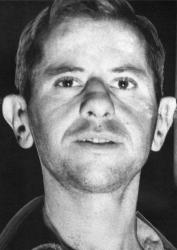
Ed Gein
 USA
USABiography of Ed Gein
Edward Theodore "Ed" Gein was an American serial killer and body snatcher. Born on August 27, 1906, in La Crosse County, Wisconsin, Gein's horrifying crimes in his hometown of Plainfield, Wisconsin shocked the public. Authorities discovered trophies and souvenirs made from bones and skin of corpses he had stolen from local cemeteries. In 1957, the police found body parts in Gein's house, and he confessed to the murders of two women: tavern owner Mary Hogan in 1954 and hardware store owner Bernice Worden in 1957. While Gein had less than three confirmed murders, he became the inspiration for several fictional serial killers, including Norman Bates from the movie "Psycho," Leatherface from "The Texas Chainsaw Massacre" franchise, and Buffalo Bill from "The Silence of the Lambs."

Early Life
Ed Gein was born to alcoholic father George and devoutly religious mother Augusta Gein on August 27, 1906. He had an older brother named Henry George Gein. Augusta deeply despised her husband but remained married to him due to her religious beliefs. She worked at a small grocery store until she bought a farm on the outskirts of the small town of Plainfield, where the family moved. Augusta, a Lutheran, moved her family to seclusion to "protect" them from the corrupting influences of the world, making the boys work hard on the farm. She convinced them that the world was immersed in debauchery and that all women, except herself, were prostitutes and instruments of the devil. Augusta read Edward and Henry passages from the Bible every day, particularly focusing on verses from the Old Testament about death, murder, and divine retribution.
Despite his shyness and delicate nature, Ed became a target for bullies. His classmates and teachers noticed that he would suddenly burst into laughter, which made others avoid him. To make matters worse, his mother punished him when he tried to make new friends. However, despite his social difficulties, Gein performed well academically, excelling in reading. He tried his best to make his mother happy, but she remained convinced that he would follow in his alcoholic father's footsteps.
In 1940, George Gein died of a heart attack, leaving the brothers to support the family through odd jobs. Both brothers gained reputations as honest and dependable members of society. Ed even occasionally babysat the neighbors' children. Unlike Ed, Henry openly criticized their mother's fanatical beliefs. On May 16, 1994, Henry died under strange circumstances while helping Ed extinguish a fire. The police, who noticed bruises on Henry's head and other suspicious circumstances, did not consider murder as a possibility. It is quite possible that Henry was killed by his brother.
Life as a Serial Killer
Ed Gein and Augusta continued living on the farm together until her death on December 29, 1945, after a series of strokes. Ed had been caring for the bedridden Augusta, who even during this time called him a failure and weakling. According to biographer Harold Schechter, Ed "lost his only friend and his one true love." Left alone, Gein did not leave the farm and left all of his mother's possessions untouched. He became fascinated with death cults, read books about anatomy, Nazi atrocities, and exhumations, and developed a love for reading obituaries.
Soon, Ed began to act on his unhealthy fantasies. On November 16, 1957, Bernice Worden disappeared, and the police quickly suspected Gein. Worden's son reported that Gein had been in his mother's store the day before, saying he would return the next morning to buy antifreeze. The receipt with the purchase of antifreeze turned out to be the last evidence. During the search of Edward's property, the police discovered a mutilated body in the barn, which the sheriff initially took for a deer carcass. Worden had been shot with a .22 caliber rifle before Gein gutted her.
Inside Gein's house, authorities found four human noses, bone fragments, nine masks made of human skin, bowls made from human skulls, chairs upholstered with human skin, the head of Mary Hogan in a paper bag, the head of Bernice Worden in a burlap sack, nine vulvas in a shoebox, a belt made of nipples, and a lampshade made of human skin with a human face. Furthermore, his refrigerator was filled with human organs. It was discovered that Edward had dug up bodies of middle-aged women who resembled his mother. All these gruesome findings were properly disposed of later.
Between 1947 and 1952, Gein made 40 night trips to three local cemeteries, where he exhumed recently buried bodies in a state of shock. He admitted that in 30 cases, he returned from the cemetery empty-handed because he regained consciousness in time. The body snatcher confessed that after his mother's death, he wanted to change his gender and began making and wearing "female suits" made from dead flesh, calling it "a crazy transvestite ritual." He denied having sex with the corpses, explaining that they smelled too bad.
Initially, Gein was sent to the Central State Hospital for the Criminally Insane and later transferred to Mendota State Hospital in Madison, Wisconsin. In 1968, doctors declared him mentally fit to stand trial, and on November 14, 1968, the court proceedings began. Gein was found guilty of premeditated murder, but due to his legal insanity, he was sent to a mental institution for the rest of his life.
During the trial, Gein's house burned down. Arson was suspected. When the criminal learned about the incident, he shrugged and said, "Well, that's how it goes."
Ed died on July 26, 1984, in Madison, Wisconsin, due to respiratory and heart failure caused by cancer. His burial plot in the Plainfield cemetery attracted vandals for many years.
Gein's car, known as "Ed Gein's Ghoul Car," which he used to transport his victims, was sold at a public auction for $760 (equivalent to $5773 adjusted for inflation).