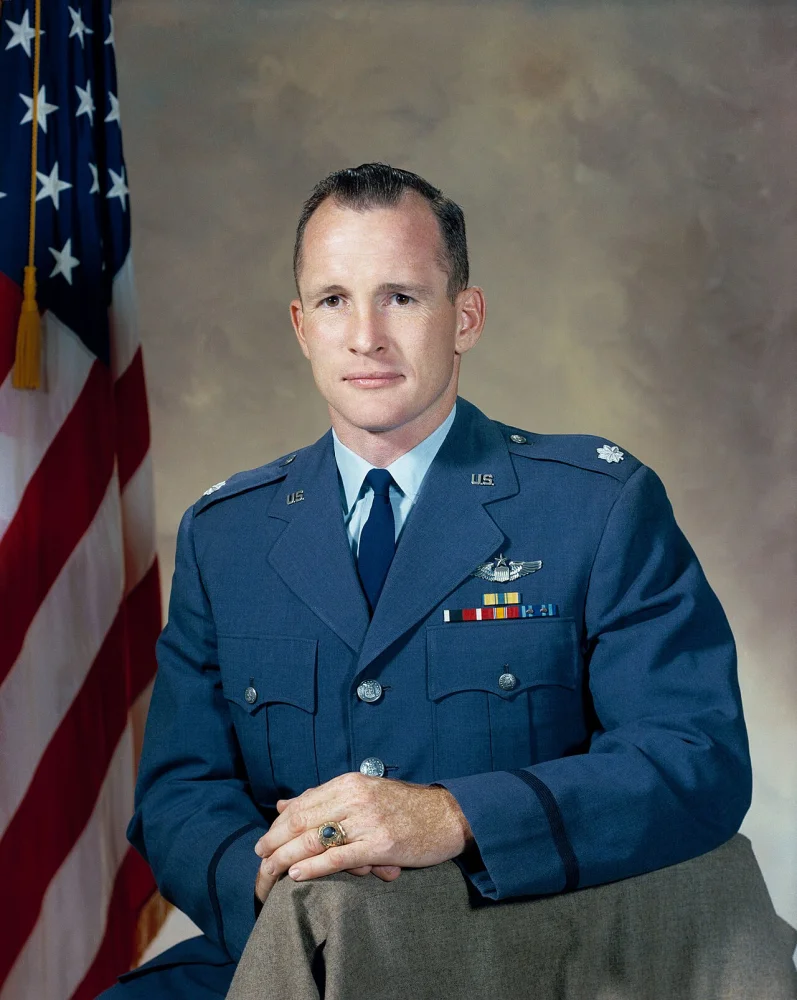
Ed White
- Early Life and Military Career
- Joining NASA
- The Gemini IV Spacewalk
- Apollo 1 and the Fire
- Family and Legacy
On 3 June 1965, Ed White opened the hatch of Gemini IV and became the first American to walk in space. Tethered to the spacecraft and carrying a small maneuvering unit, he spent 23 minutes moving outside the capsule while his crewmate James McDivitt watched from within. Two years later, White was killed in a ground test for Apollo 1, a tragedy that halted the program and forced sweeping changes to spacecraft safety.
Early Life and Military Career
Edward Higgins White II was born in San Antonio, Texas, on 14 November 1930. His father, Edward H. White Sr., was a career military officer and pilot, and the family moved frequently as his father’s assignments changed. White attended the United States Military Academy at West Point, graduating in 1952 with a bachelor’s degree in science.
He joined the U.S. Air Force and became a fighter pilot, serving in West Germany before training as a test pilot. After graduating from the Air Force Test Pilot School at Edwards Air Force Base in 1959, he worked as an experimental test pilot at Wright-Patterson Air Force Base in Ohio. He also completed advanced study in aeronautical engineering at Purdue University. Test flying suited the qualities NASA sought in its early astronaut corps: technical skill, discipline, and composure in unfamiliar conditions.
Joining NASA
NASA selected White in 1962 as part of Astronaut Group 2, often called the “New Nine.” The group was recruited for the increasingly complex Gemini and Apollo programs. White trained for orbital missions, spacecraft operations, and the physical demands of working outside a capsule.
His first and only spaceflight was Gemini IV, launched on 3 June 1965 with McDivitt as commander. The four-day mission was designed to test spacewalking as well as spacecraft maneuvering and other procedures needed for future missions. Soviet cosmonaut Alexei Leonov had performed the first human spacewalk in March of that year; White became the first American to follow.
The Gemini IV Spacewalk
White’s spacewalk began over the Pacific Ocean near Hawaii and ended over the Gulf of Mexico. Secured by a tether and umbilical, he floated outside the capsule for about 23 minutes. He used a hand-held gas-powered maneuvering unit to move around, although its propellant ran out after only a few minutes. The excursion still gave him direct experience moving in the weightless environment and produced one of the era’s defining images: a suited astronaut suspended above Earth.
White later described the experience as extraordinary. Returning to the capsule was difficult because he was reluctant to end the spacewalk, but he followed instructions and re-entered safely. Gemini IV demonstrated that an astronaut could leave and return to a spacecraft, an important step toward the work planned for Apollo and later missions.
Apollo 1 and the Fire
White was assigned as senior pilot for the first crewed Apollo mission, alongside command pilot Virgil “Gus” Grissom and pilot Roger Chaffee. The mission was still in preparation when the crew entered their command module at Cape Kennedy on 27 January 1967 for a launch rehearsal known as a “plugs-out” test.
A flash fire swept through the cabin during the test. The spacecraft’s pressurized pure-oxygen atmosphere and flammable interior materials allowed the fire to spread rapidly, while the inward-opening hatch made escape difficult. White and his crewmates died from asphyxiation caused by smoke and toxic gases. The mission had not launched, and the name “Apollo 1” was later formally assigned in their memory.
The investigation prompted extensive changes to spacecraft materials, cabin atmosphere, hatch design, wiring, and test procedures. White’s death, along with those of Grissom and Chaffee, became a defining loss for NASA and a turning point in the effort to make human spaceflight safer.
Family and Legacy
White married Patricia Finegan, and they had two children, Edward and Bonnie. He received numerous honors during his career, including the NASA Exceptional Service Medal and Distinguished Flying Cross. In 1997, he and the other Apollo 1 astronauts were posthumously awarded the Congressional Space Medal of Honor.
White’s legacy spans both achievement and sacrifice. His Gemini IV spacewalk helped establish the practical techniques needed for astronauts to work outside their craft, while the Apollo 1 tragedy exposed how small design and procedural risks could combine into disaster. His brief career remains a vivid chapter in the story of human spaceflight.


