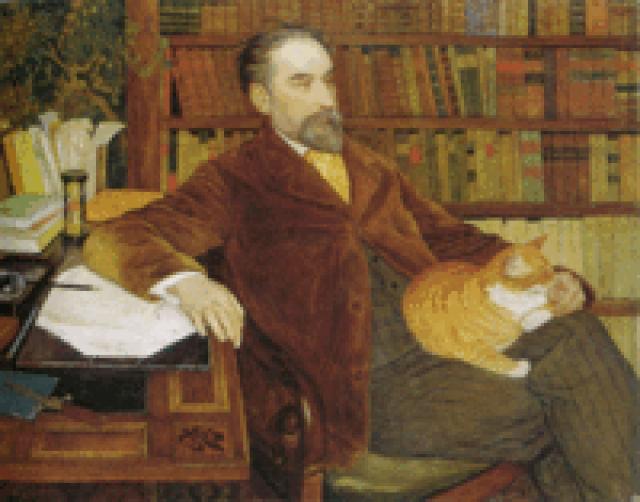
Eduar Rod
 Switzerland
- Édouard Rod: Swiss Writer and Literary Scholar
- Early Literary Career
- Academic and Literary Shift
- Psychological Mastery
- Historical Studies
- Influence and Legacy
Édouard Rod: Swiss Writer and Literary Scholar
Édouard Rod (1857-1910) was a renowned Swiss writer and literary scholar. He studied at the University of Lausanne, where he earned his doctorate with a thesis on the Oedipus legend. From 1878, he resided in Paris, where he immersed himself in the literary scene.
Early Literary Career
In 1881, Rod published his naturalistic novel "Palmyre Veulard," dedicated to his mentor Émile Zola. He continued to produce works in this genre, gaining recognition for his skillful depiction of moral dilemmas and conflicts. In 1884, he became editor of the journal "La Revue contemporaine."
Academic and Literary Shift
In 1887, Rod was appointed Professor of Comparative Literature at the University of Geneva, a position he held until 1893. During this time, his writing underwent a significant shift. His novel "La Course de la mort" (1888) marked a departure from naturalism, exploring the interplay between passion and duty.
Psychological Mastery
Rod's subsequent novels, such as "Le Sens de la vie" (1889) and "Les trois cœurs" (1890), showcased his profound psychological analysis. He delved into complex moral dilemmas, examining the struggle between conscience and desire. His intimate-psychological novels provided a nuanced exploration of human emotions.
Historical Studies
Alongside his literary works, Rod also authored several historical-literary monographs, including "Les Allemands à Paris" (1880) and "Les Protestants. Côte à côte" (1882). These studies demonstrated his erudition and critical insight.
Influence and Legacy
Édouard Rod's work was influenced by the philosophical ideas of Arthur Schopenhauer and Leo Tolstoy. His writings continue to be admired for their perceptive analysis of human nature, their exploration of moral ambiguity, and their contribution to the development of psychological realism in literature.


