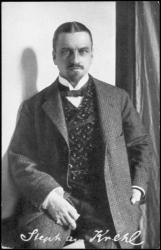
Eduard Napravnik
- Édouard Franz Eduardovich Nápravník: A Musical Mastermind
- The Russian Connection
- An Orchestral Trailblazer
- Opera Premieres and Collaborations
- Symphonic Masterpieces and Compositional Legacy
- Technical Virtuosity and Orchestral Mastery
- Acknowledgment and Legacy
Édouard Franz Eduardovich Nápravník: A Musical Mastermind
Early Life and EducationÉdouard Franz Eduardovich Nápravník, renowned conductor and composer, was born in the Czech Republic on August 12, 1839. After losing his father at an early age, Nápravník left his formal schooling and pursued his passion for music. He studied under Blažek and Pitcha at the organ school and under Maydel at the piano school, where he soon became an instructor. Nápravník later honed his orchestration skills under the guidance of Kittel.
The Russian Connection
In 1861, Nápravník found a position as music director for Prince Yusupov and made his way to St. Petersburg. Russia quickly became his adopted home. Two years later, he joined the Russian opera as assistant conductor and organist, and in 1867, he was appointed second conductor.
An Orchestral Trailblazer
Nápravník's tenure as head of the Russian opera orchestra was characterized by his meticulous and flawless ensemble playing. He significantly elevated the organization and quality of both the orchestra and choir. He also played a vital role in improving the financial well-being of the musicians.
Opera Premieres and Collaborations
Nápravník conducted numerous opera performances, premiering over 60 operas (including 40 Russian works) and reviving over 30. He introduced operas by composers such as Kashperov, Cui, Moniuszko, Serov, Dargomyzhsky, Rimsky-Korsakov, Mussorgsky, Tchaikovsky, Rubinstein, and more.
Symphonic Masterpieces and Compositional Legacy
From 1869 to 1881, Nápravník conducted the symphony concerts of the Imperial Russian Musical Society. He also served as a member of the society's directorate. His compositional output included fugues, male choruses, piano pieces, an overture for orchestra, a sonata for violin and piano, and a symphony. His operas, such as "Nizhegorodtsy," "Harold," "Dubrovsky," and "Francesca da Rimini," were highly successful in St. Petersburg.
Technical Virtuosity and Orchestral Mastery
Nápravník's conducting was marked by its precision and musicality, though it lacked passion and fervor at times. His compositions displayed excellent technique, skillful instrumentation, and often beautiful melodies. However, they tended to lack a distinctive individual voice, reflecting the conventional style of a conductor's music.
Acknowledgment and Legacy
Nápravník's contributions to Russian music were recognized through several published works, including V. F. Stasov's biography, the "Obituary" published in "Bayan" magazine, and articles in various music publications. He left behind a lasting legacy as a conductor and composer who played a significant role in shaping the musical landscape of his time.