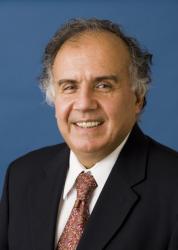
Edward Franciszek Szczepanik
 Poland
- Early Life and Education
- Military Service and World War II
- Post-War Career
- Political and Diplomatic Roles
- Academic and Consulting Experience
- - Assistant at the Warsaw School of Economics (1938-1939)
- Advisory and International Collaborations
- - United Nations High Commissioner for Refugees in Hong Kong (1954)
- Legacy and Honors
Early Life and Education
Edwrad Franciszek Szczepanik was born on August 22, 1915, in Suwałki, then a small town in northern Poland under German occupation during the Imperial Russian period. He pursued his primary education in Suwałki before graduating from the local gymnasium. Subsequently, Szczepanik enrolled at the Warsaw School of Economics (SGH), where he earned his master's degree in political economy in 1936 under the guidance of Professor Edward Lipiński.
Military Service and World War II
During his mandatory military service, Szczepanik trained at the artillery officers' school and served in the 29th Light Artillery Regiment. He received a scholarship to study at the London School of Economics under notable economists such as Lionel Robbins, Friedrich Hayek, and Paul Narcyz Rosenstein-Rodan.
Upon the outbreak of World War II, Szczepanik was interned in Lithuania but later captured by Soviet forces. He was detained in Kozielsk and Kola Peninsula, notorious Gulag prison camps, from 1940 to 1942. After Germany invaded the Soviet Union and the Sikorski-Mayski Agreement was signed, Szczepanik was liberated and joined General Władysław Anders' 2nd Polish Corps.
Post-War Career
Returning to Warsaw after the war, Szczepanik completed his education and earned his master's degree in economics from the London School of Economics in 1953 and his doctorate in 1956. He worked as an assistant at Lipiński's department at the Warsaw School of Economics.
Political and Diplomatic Roles
In 1981, Szczepanik became the Minister of the Interior of the Polish government-in-exile. On April 7, 1986, he was elected as its Prime Minister, a position he held until December 22, 1990.
Academic and Consulting Experience
Throughout his career, Szczepanik held various academic and consulting roles, including:
- Assistant at the Warsaw School of Economics (1938-1939)
- Lecturer at the Polish University College in London (1947-1953)- Professor at the University of Hong Kong (1953-1961)
- Consultant at Harvard University in Karachi, Pakistan (1961-1963)
- Senior research fellow at the University of Sussex (1978-1981)
- Professor of economics at the Polish University Abroad in London (1981)
Advisory and International Collaborations
He also served as a consultant for various international organizations:
- United Nations High Commissioner for Refugees in Hong Kong (1954)
- United Nations Economic and Social Commission for Asia and the Pacific in Thailand (1956)
- Food and Agricultural Organisation in Hong Kong (1954-1955) and in Rome (1963-1977)
Legacy and Honors
Edwrad Franciszek Szczepanik passed away on October 11, 2005, in Worcestershire. He was buried with military honors in his hometown of Suwałki. Szczepanik's contributions to economics, diplomacy, and the advancement of Polish culture left a lasting legacy.