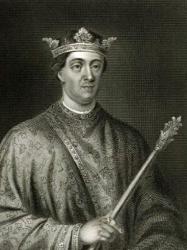
Edward the Confessor
 Great Britain
Biography of Edward the Confessor
Edward the Confessor was born in Islip, Oxfordshire, and was the first son from the second marriage of King Æthelred II the Unready and Emma of Normandy. In 1003, Danish raiders began ravaging England in retaliation for the massacre of Danish settlers in 1002. The royal family sought refuge in Normandy when the Danes landed again in 1013. In 1017, Emma married Cnut, the Danish leader who had conquered England in 1016 and became king. Edward remained outside of England, primarily in Normandy and Flanders, until 1041 when he was called back by his half-brother King Harthacnut to be his heir.
Upon ascending the throne in 1042, Edward faced difficulties as he was seen as an outsider in his own kingdom, with provincial earls holding most of the power. Wessex, Edward's hereditary county, was given to Earl Godwin by Cnut. There was also a threat from foreign claimants to the throne. Nevertheless, Edward successfully overcame these challenges. He initially defended his crown with the help of his son-in-law, Emperor Henry III of the Holy Roman Empire, and later found common ground with his cousin William, Duke of Normandy (later known as William the Conqueror). In England, Edward capitalized on the rivalries between the earls and managed to rally supporters, primarily through his patronage of the Church. However, his actions to consolidate his personal power were often met with backlash. For example, although Edward defeated his father-in-law Earl Godwin and exiled him in 1051, he allowed him to return the following year after Godwin's death in 1053.
The question of succession was of paramount importance during Edward's reign. Edward married Edith in 1045, but their marriage was childless. It is likely that from 1050 onwards, Edward consistently wanted William to succeed him. In 1051, Godwin was forced to provide hostages to William, and in 1054, Harold, Earl Godwin's son, swore allegiance to William as Edward's successor. However, these actions were met with little enthusiasm in England. In 1057, Edward the Exile returned to the country, but he died shortly after, leaving behind underage children who were not considered serious contenders for the throne. On his deathbed in London on January 4 or 5, 1066, Edward accepted the inevitable and named Harold, his son-in-law, as his heir.
Edward supported peace, lowered taxes, and implemented monetary reforms. He was also a warrior by nature. After the death of Cnut in 1036, he possibly led incursions into England, and at the beginning of his reign, he personally commanded the English fleet when the country was under threat. His earls conquered Wales and deterred Scottish raids. In his later years, Edward became a devoutly religious man. He rebuilt Westminster Abbey, where he desired to be buried. In the final years of his life, some courtiers, possibly French, attributed miraculous abilities to Edward, similar to those claimed by the Capetians. In 1065-1067, a monk from Saint-Omer wrote his first biography in this spirit. The cult of Edward, associated with the chastity of his marriage, developed at Westminster in the 12th century, along with many legends surrounding his life. In 1161, Pope Alexander III canonized Edward the Confessor.