Eisaku Sato
 Japan
Japan- Early Life and Career
- Entry into Politics and Rise to Power
- Political Scandals and Recovery
- Premiership
- Nobel Peace Prize and Legacy
Early Life and Career
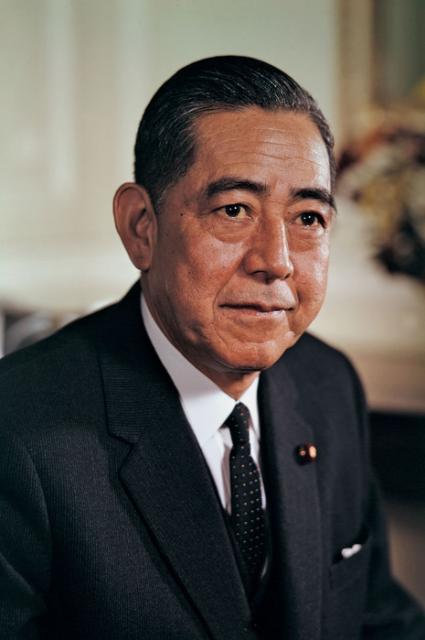
Eisaku Satō, born in Tabuse, Yamaguchi, was the youngest of three sons to Hidesuke Satō, a former government official and amateur poet who operated a liquor business. One of his brothers, Ichirō, became an admiral, while two others, Eisaku and Nobusuke, served as prime ministers of Japan.
After graduating from Kuni Elementary School in Tabuse and Kumamoto High School, Satō enrolled in Tokyo Imperial University and studied German law. Upon graduating with a law degree in 1924, he initially sought employment in the Ministry of Finance but was placed in the Ministry of Railways. In 1926, Satō married his cousin, Hiroko Satō, and had two sons.
Satō's abilities were recognized during his service, and he held several important positions, including Director of the Osaka Railway Bureau (1944-1946) and Vice Minister of Transportation (1947-1948).
Entry into Politics and Rise to Power
In March 1948, Satō left the transportation industry to pursue politics. He joined the Democratic-Liberal Party and became chairman of its Yamaguchi Prefecture chapter. In October, Prime Minister Shigeru Yoshida appointed him to his cabinet. Yoshida had intended to do so immediately after World War II, but the American occupation authorities blocked Satō's appointment due to his brother Nobusuke's involvement in the wartime cabinet and suspicion of war crimes. However, Nobusuke (who had changed his surname to Kishi in accordance with Japanese marriage customs) was later acquitted, and the brothers entered politics.
In the 1949 parliamentary election, Satō helped rally support for his party. He became one of Prime Minister Yoshida's close aides, serving first as Chief Cabinet Secretary (1951-1952) and then as Minister of Construction (1952-1953), before being elected Secretary-General of the party.
Political Scandals and Recovery
Satō's career suffered a setback in 1954 when he and several other politicians were accused of receiving bribes from a shipbuilding company. While he was eventually cleared of the charges, the party suffered damage. Satō remained out of politics until 1957, when he was elected Chairman of the Executive Committee of the newly formed Liberal Democratic Party (LDP), which was headed by his brother. In 1958, Nobusuke Kishi became prime minister of Japan and appointed his brother as Minister of Finance.
In 1960, Hayato Ikeda, a classmate of Satō, was elected Prime Minister and invited him to serve as Minister for International Trade and Industry. Satō resigned from the cabinet in July 1962, seen as a bid for the premiership, and embarked on a foreign tour where he met with leaders of France, the United States, and other major powers. Despite disagreements with Ikeda, whom he criticized as weak, Satō rejoined his cabinet in July 1963 and remained until late 1964.
He then announced his candidacy for party leadership, which would have made him prime minister if elected. Although Ikeda retained the leadership, he was forced to resign due to ill health in October 1964. After some hesitation, Ikeda named Satō as his successor, and he was elected Prime Minister by Parliament on November 9, 1964.
Premiership
Upon assuming office, Satō announced his intention to strengthen Japan's international position while maintaining postwar pacifism. "I think unarmed and denuclearized nations such as Japan should play more significant roles in preserving the peace," Satō said after his inauguration.
The Prime Minister pledged to continue close cooperation with the United States and reaffirmed Japan's postwar constitution, which stated, "War and the threat or use of force as a means of settling disputes with other nations is forever renounced." This was particularly significant as Japan's military policy was at a crossroads with the nation's growing economic power. Satō made clear Japan's condemnation of nuclear weapons and declared his determination to "neither produce such weapons nor possess or admit them into Japan."
Satō sought to improve Japan's relations with its neighbors. In 1965, he signed a treaty of friendship and restored diplomatic relations with South Korea, a former victim of Japanese aggression. Two years later, Satō embarked on a tour of the Philippines, Australia, New Zealand, South Vietnam, Laos, Thailand, Singapore, Malaysia, Indonesia, and Burma, fostering trade and cultural ties.
During the Vietnam War, Satō attempted to mediate, yet he also disappointed many Japanese when he approved American bombing of North Vietnam in 1968.
Through close ties with the United States, Satō achieved a major diplomatic victory: the peaceful return to Japan of the Okinawa and Ogasawara Islands. The United States had captured these islands during World War II in a fierce battle. After five years of negotiations, Japanese sovereignty was restored in 1972. Satō pursued better relations with the Soviet Union and China but with little success. In July 1972, he resigned as Prime Minister amid internal party divisions.
Nobel Peace Prize and Legacy
Firmly steering Japan on a pacifist course, Satō was awarded the Nobel Peace Prize in 1974, which he shared with Seán MacBride. "In halting the tendencies towards a revival of nationalistic policies in postwar Japan, in stressing continuously the need for international cooperation, in acting as an arbitrator and thereby helping to smooth out differences, Satō has made his main contribution to the cause of peace," said Åse Liestøl, a representative of the Norwegian Nobel Committee. Liestøl also noted that Satō's leadership was instrumental in Japan's condemnation of nuclear weapons—a unique stance among major powers.
Upon accepting the award, Satō called on the United States and the Soviet Union to pursue nuclear disarmament. He also spoke of the need for an international agreement for cooperation in the peaceful uses of atomic energy. Satō's selection as a Nobel laureate was met with some skepticism. While Japanese people were pleased with the recognition of their country's anti-militarism, many questioned Satō's pacifism. They recalled his approval of the bombing of North Vietnam, his opposition to the admission of the People's Republic of China to the United Nations, and his slow progress in restoring normal relations with Beijing.
On May 19, 1975, Satō suffered a cerebral hemorrhage while dining at a restaurant. Two weeks later, he passed away.