Eliezer Shteinberg
 Romania
- Early Life
- Literary Career
- Recognition and Influence
- Educational Contributions
- Life in Brazil
- Literary Legacy
- Posthumous Recognition
Early Life
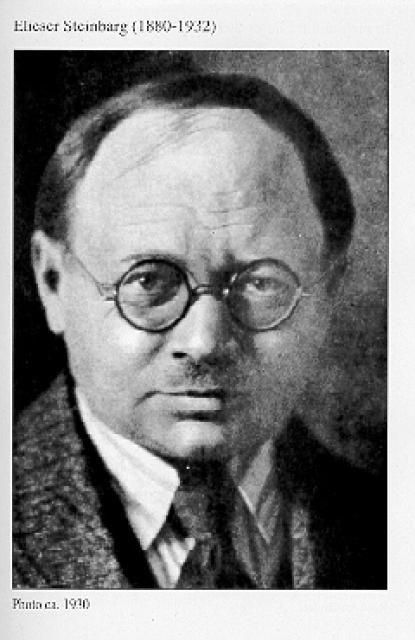
Eliezer Steinbarg was born into a Jewish family in the small town of Lipcani, Bessarabia (now Moldova), in the late 19th century. He had a close relationship with his cousin, the writer Judah Steinberg, and lived in Lipcani until 1919. There, he worked as a teacher of Yiddish and Hebrew, advocating for Jewish bilingualism.
Literary Career
Steinbarg began publishing plays, poems, and educational materials in the local press, including stories and essays in Yiddish periodicals. His plays, often based on biblical and historical themes, were popular in local theaters. In 1910, he published his first fables, which showcased his unique blend of colloquial Bessarabian Yiddish with biblical and Talmudic allusions.
Recognition and Influence
In 1914, Steinbarg met the renowned Hebrew poet Chaim Nachman Bialik, who praised his fables. Bialik planned to publish Steinbarg's work in his "Moria" anthology, but the outbreak of World War I prevented that. Bialik's critical analysis of Steinbarg's fables cemented his reputation as a master fabulist.
Educational Contributions
In 1919, Steinbarg became the head of the Jewish School Association in Chernivtsi, now Ukraine. He played a pivotal role in organizing Jewish education and developed a groundbreaking methodology for teaching both Yiddish and Hebrew. His educational materials, such as "Kultur," had a profound impact on Jewish pedagogy.
Life in Brazil
In 1928, Steinbarg moved to Rio de Janeiro, Brazil, where he led a Jewish school. However, he returned to Chernivtsi two years later and continued his literary and educational work.
Literary Legacy
Steinbarg's untimely death in 1932 cut short his promising career. He left behind a collection of over 500 fables, of which 99 were published posthumously in 1932. His fables have been translated into several languages and have been widely anthologized and performed by popular reciters.
Posthumous Recognition
The death of Steinbarg was mourned by thousands, and he was recognized as a classic of modern Jewish literature. His fables have been published numerous times in various editions, and his archives have been preserved at the Jewish National and University Library in Jerusalem. In Chernivtsi, there is a street named after him and a Jewish cultural society dedicated to his memory. Steinbarg's literary legacy continues to inspire and entertain readers worldwide.