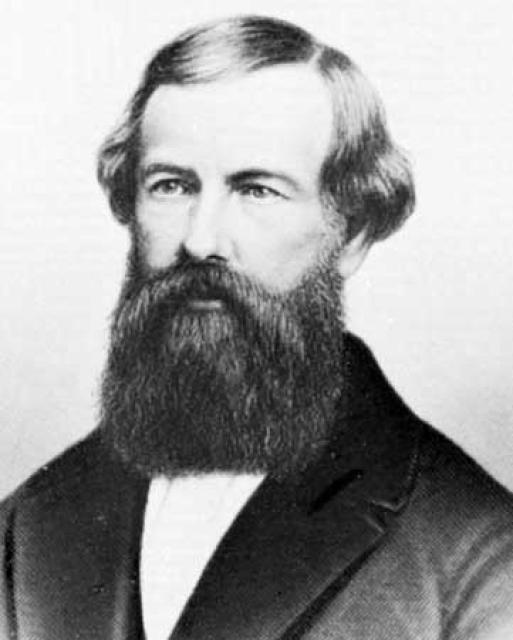
Elisha Otis
 USA
USABiography of Elisha Otis
Elisha Graves Otis was born in 1811 in Halifax, Vermont to Stephen Otis, Jr. and Phoebe Glynn. At the age of 20, he left his parental home and eventually settled in Troy, New York, where he worked as a mechanic for five years. In 1834, he married Susan A. Houghton, with whom he had children. During this period, Otis struggled to establish his own business and faced financial difficulties. He also survived a severe bout of pneumonia that nearly took his life. Sadly, his wife passed away, leaving Otis with eight sons, the youngest of whom was still an infant.
At the age of 34, Otis began a "new" life and moved to Albany, New York, where he worked in a factory manufacturing bed frames. It was during this time that he first encountered the safety issues with freight elevators when he was assigned to oversee the construction of a new building.
Invention of the Safe Elevator
When installing an elevator in the building, Otis used the conventional mechanism for lifting cargo, which was far from perfect. Soon, Otis developed his own system for elevator safety in case of a rope or cable breakage. His method was relatively simple: if the rope broke while lifting the cargo to the upper floors, a specially installed spring would straighten and activate the braking system, causing the elevator cabin to be caught by safety devices.
Unfortunately, the company where Otis worked went bankrupt, leaving him unemployed. However, fate finally smiled upon the inventor, and soon two neighboring factories, who had heard of his invention, commissioned him to build safe elevators. Nevertheless, Otis gained true recognition when the first safe passenger elevator was launched. From 1852, he worked on his own project, and in 1854, Elisha Otis truly astonished the public. At the New York Crystal Palace exhibition, Otis demonstrated the safety of his lifting device in a highly extravagant manner. He stood on an open platform of the elevator, which was loaded with heavy cargo, while his assistant, in front of a stunned audience, chopped the rope holding the platform with an axe. To the surprise and even amazement of the spectators, the elevator platform, installed at approximately the fourth floor level, remained in place and did not fall.
This impressive trick became a hit at the exhibition, and the first safe passenger elevator with Otis' device was installed in New York in 1857. Interestingly, at that time, the inventor himself did not suspect that his safety device would soon be widely used in the construction of skyscrapers. It was the combination of Otis' elevator and the invention of steel frame structures that made the construction of skyscrapers possible.
Legacy and Personal Life
Otis worked on his devices in a very original way - he never used a drafting board, did not draw plans, or even make sketches. He only made plans for his devices with minimal compliance with the requirements of the Patent Office. Difficult times for the inventor were left behind as orders for the production of new safe elevators began to come in regularly, and his family business began to prosper. After Otis' death, his sons continued the family business.
Elisha Graves Otis died prematurely during a diphtheria epidemic on April 8, 1861, just a few months before his 50th birthday.