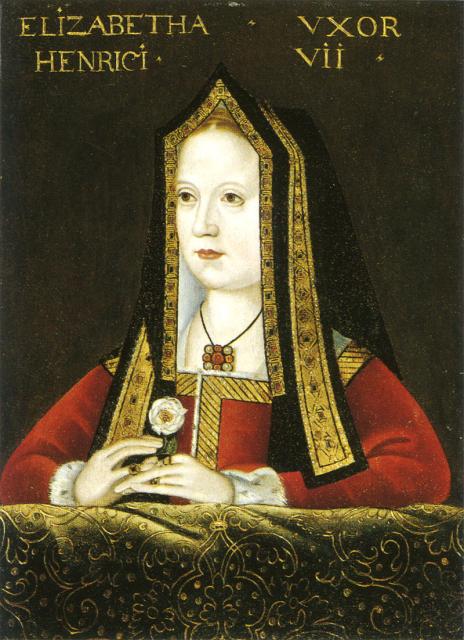
Elizabeth of York
 Great Britain
- Elizabeth of York: Princess and Matriarch of the Tudor Dynasty
- Daily Routine
- Safety and Security
- Education and Upbringing
- The Crisis of 1469-1471
Elizabeth of York: Princess and Matriarch of the Tudor Dynasty
Origins and Early YearsElizabeth of York was born on February 11, 1466, at Westminster Palace as the eldest of ten children of King Edward IV of England and Elizabeth Woodville. She had two half-brothers from her mother's previous marriage to John Grey of Groby: Thomas and Richard.
Princess Elizabeth was the first princess born in England in that century. Her baptism took place in February 1466 at St. Stephen's Chapel, Westminster Palace, with a lavish ceremony that mirrored that of a prince. She was christened by Archbishop George Neville of York and held at the font by her grandmothers, Cecily Neville and Jacquetta of Luxembourg, and Edward IV's close ally, Richard Neville, 16th Earl of Warwick.
Despite tradition prohibiting the king and queen from attending their child's christening, Edward IV made an exception for his daughter, possibly to quell rumors that his marriage to Elizabeth Woodville was illegitimate and that hers was a bastard birth. The king gifted his wife with jewelry worth 125 pounds to mark Elizabeth's arrival, and her churching ceremony, held in late March of that year, was also an elaborate occasion.
In 1467, the king granted the use of Sheen Palace in Surrey to his wife as her dower, where a royal nursery was established. Here, Elizabeth spent her early childhood alongside her sister Mary, born on August 11, 1467. Under the guidance of their governess, Margaret, Lady Berners, who earned 100 pounds annually for her services, the princesses were raised with an extensive household staff and an allowance of 400 pounds per year.
In 1467, the young Elizabeth was granted the manor of Great Linford in Buckinghamshire, which had belonged to James Butler, Earl of Wiltshire, until 1461. The reason for this grant is unclear, but it may have been intended as compensation for the princess not having a title. The manor's income was used to cover some of the expenses of Elizabeth's nursemaids.
Elizabeth grew up in "the most magnificent of all Christian courts" and was accustomed to travel from an early age as the royal family, along with their children and an extensive entourage, moved between nearly one hundred royal residences, mostly located within the Thames Valley.
Daily Routine
Elizabeth and Mary's daily routine likely resembled that established by the king for their brother Edward when he turned three and may have been based on the customs described in household books of their paternal uncle, George, Duke of Clarence.
The children were awakened at approximately six o'clock in the morning so they could "arise at a convenient hour according to their age" to attend morning prayers in their chamber. A bell then summoned them to Mass, celebrated by their household chaplain in the local chapel. Regular attendance at liturgical services was considered essential for the king's children, and Elizabeth grew up as a highly pious woman.
Immediately after Mass, the princesses had breakfast, which likely consisted of bread, butter, ale, fish, meat, or eggs. Dinner was served at ten or eleven o'clock in the morning, a "noble service" of dishes "brought by gentlemen" and squires in livery that could last until two o'clock. The sisters were entertained with instructive and polite stories during meals.
After dinner, the princesses took a bath and possibly had an afternoon nap. Later, they were served refreshments along with bread, and a bell summoned them to Evensong. Supper was served at four o'clock in the afternoon. The remainder of the evening was devoted to recreation, such as games and music. The king's daughters typically retired at approximately eight o'clock, after receiving bedtime snacks of bread, ale or wine, and other items.
Notably, there is little mention of toys in the household accounts of the princesses during this period.
Safety and Security
Great attention was paid to the princesses' safety. After eight o'clock at night, when Elizabeth and Mary's chamber doors were locked, no one except their personal servants could enter. A candle or torch was kept burning in their bedroom throughout the night, and the outer gate was locked at nine o'clock in the winter and ten o'clock in the summer. Guards patrolled the castle grounds three or four times each night, checking every room. A special man was later assigned to Prince Edward who slept in his chamber and was responsible for the boy's safety and well-being at night. The princesses probably had similar arrangements.
Education and Upbringing
Religious instruction for the royal children began at a very early age, and by the age of four, they were expected to know the Psalter. Feast days, including Candlemas, Easter, St. George's Day, Trinity Sunday, All Saints' Day, Christmas Day, and saints' days, were marked with special chapel services, sermons, and festivities. Elizabeth and Mary made offerings during Mass on these occasions.
On Maundy Thursday, the girls distributed gifts to the poor, and on Good Friday, they were taught to crawl to the cross on their knees. During Lent and Advent, the girls fasted or abstained from meat. On New Year's Day, the princesses received gifts, and on Twelfth Night, they were permitted to join in the festivities and feasting.
In June 1470, Princess Elizabeth traveled with her parents to attend the Whitsun celebrations at St. Augustine's Abbey in Canterbury, after which she returned to London with her mother. At the abbey, Elizabeth encountered the relics of Thomas Becket, whose life and miracles left an enduring impression on the young princess. There is evidence that Elizabeth maintained a devotion to St. Thomas Becket throughout her life.
As Elizabeth matured, she is said to have lost her more agreeable paternal characteristics, including her natural ease and charm. Additionally, Edward IV grew stout and indulged in mistresses, most notably Jane Shore, in his later years. Elizabeth was undoubtedly aware of her father's affair with Shore and her mother's dislike of her.
While Elizabeth's apparent virtue may have masked a sensual nature akin to her father's, as she clearly took pleasure in the finer things in life, she preferred to keep this concealed. The "Blind Poet" and monk, Bernard Andre, who later served in the court of Henry VII, wrote of Elizabeth: "The deeds of praise of Elizabeth when she was yet a girl, are not to be passed over in silence. She showed from her tenderest years a devoted love and fear of God, most ready obedience to her parents, an unbounded affection for her brothers and sisters, and for the poor and servants of Christ, from her childhood instilled in her, a worshipful and especial attachment."
The young princesses were sometimes summoned to court, where they attended festivals and state visits. At court, Elizabeth and Mary joined their mother's retinue, learning etiquette, music, singing, dancing, embroidery, and everything deemed necessary to prepare them for their future roles as queen consorts, mothers, and "ornaments of the court." The girls were attired in miniature versions of the sumptuous gowns worn by noble ladies, and as they grew older, they were instructed how to manage heavy fabrics, long trains, and elaborate headdresses.
Good manners were instilled in the princesses from a young age. The young princesses were brought up with the deepest veneration for their parents, whom they did not see frequently. Each evening when they were together, the girls knelt before their father and mother and longed for their blessing, which was given "in the name of the Father and the Son and the Holy Spirit."
Elizabeth's early education was undertaken by her governess, Lady Berners. Upon Elizabeth's betrothal to the French dauphin, she began studying French and Spanish. Later reports by courtiers indicate that Elizabeth possessed an excellent command of English and French, was highly literate, and learned readily. Her ability to read opened up the popular historical romances of the time and other works describing foreign lands. She also studied Latin to assist her in reading her prayer book, but she never mastered it. Elizabeth, like her maternal relatives, was equally skilled in reading and writing, although for most of the aristocracy in the kingdom, only reading was a priority, and they often could only sign their name.
The Crisis of 1469-1471
In March 1469, Queen Elizabeth gave birth to another daughter, Cecily, which aroused serious concerns for the king and made him speculate that his eldest daughter Elizabeth would likely succeed him. The previous year, rumors began circulating at court of a widening rift between the king's supporter, Earl Warwick, and the queen, whose numerous relatives were displacing the earl at court. A serious rift had opened between Edward IV and Warwick in 1468 over the marriage of the king's sister Margaret. Warwick, who had failed to arrange an alliance with France by marrying the king to a French princess, wanted to forge a union with France through Margaret's marriage to the French prince. However, Edward IV, advised by the Woodvilles, married her instead to France's enemy, the Burgundian Duke Charles, whom Warwick hated and despised.
By 1469, the enmity between Warwick and the royal couple culminated in the earl's


