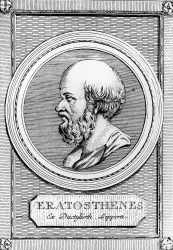
Eratosthenes
Eratosthenes was a Greek scholar whose questions ranged from poetry and chronology to mathematics and geography. His most celebrated achievement was a bold attempt to measure Earth’s circumference using shadows, geometry, and the distance between two Egyptian cities. Working more than two thousand years before modern surveying tools, he produced a result that showed just how much could be learned from careful observation and clear reasoning.
A scholar in Alexandria
Eratosthenes was born in Cyrene, a Greek city on the coast of present-day Libya, around 276 BCE. He studied in Athens before moving to Alexandria, where the Ptolemaic rulers had gathered scholars and texts at the Mouseion and its famous library. Around 240 BCE, Ptolemy III appointed him chief librarian.
The job placed Eratosthenes at the center of an ambitious intellectual community. He worked across disciplines, writing about mathematics, astronomy, geography, poetry, and literary history. He is credited with organizing a systematic description of the known world and producing a map based on measurements and reports from travelers. He also devised a practical way to identify prime numbers, now called the sieve of Eratosthenes.
Measuring the Earth with shadows
Eratosthenes’ most famous calculation began with an observation about the summer solstice. At Syene, a town south of Alexandria, the Sun was said to stand nearly overhead at noon, illuminating the bottom of a deep well and casting almost no shadow from a vertical object. At the same moment in Alexandria, a vertical pointer did cast a shadow.
From the shadow, Eratosthenes estimated the angle between the Sun’s rays and the pointer at Alexandria as about 7.2 degrees—roughly one-fiftieth of a full circle. He combined this angle with an estimate of the distance between Syene and Alexandria, traditionally given as 5,000 stadia. Multiplying that distance by fifty yielded a circumference of about 250,000 stadia.
The calculation depended on assumptions: that the cities lay nearly on the same north-south line, that the Sun’s rays reached both places in parallel, and that the reported distance was reliable. The exact modern value of his result is difficult to judge because the length of the ancient stadion is uncertain. Even so, the method was ingenious. It treated Earth as a sphere and used local measurements to infer its global scale.
A legacy across fields
Most of Eratosthenes’ own writings have been lost. Later authors preserved accounts of his work, which means that details and attributions are sometimes debated. What survives is enough to show an exceptional range of interests and a habit of connecting disciplines rather than keeping them separate.
Eratosthenes died in Alexandria around 194 BCE. His measurement of Earth remains a landmark in the history of science, not because every assumption was exact, but because he showed how geometry could turn a simple difference in shadows into a question about the whole planet. His name also lives on in the mathematical sieve that generations of students have used to sort prime numbers.