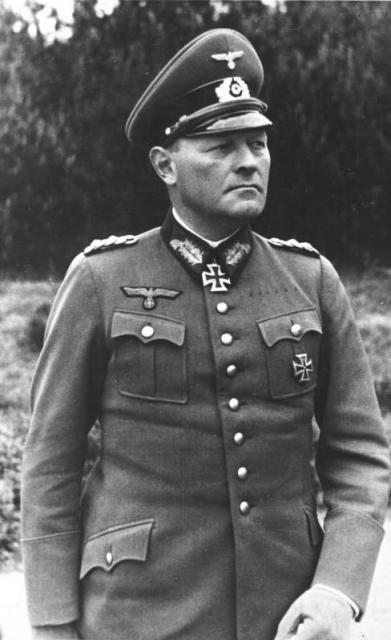
Erich Hoepner
 Germany
- Early Life and Military Career
- World War I
- Interwar Period
- World War II
- Dismissal and Retirement
- July 20 Plot and Execution
- Awards
- Honor Cross of the World War 1914/1918
Early Life and Military Career
Erich Hoepner was born in Frankfort an der Oder, Germany, on September 14, 1886. In March 1905, he joined the German Army as a fanen-junker (officer candidate) in the 13th Schleswig-Holstein Dragoon Regiment. He was commissioned as a lieutenant in August 1906.
World War I
Prior to the outbreak of World War I, Hoepner studied at the Military Academy in Berlin. From February 1914, he served as a first lieutenant. During the war, he was an adjutant in the staff of the 16th Army Corps. He was promoted to captain in June 1915 and served in various staff positions at the corps and army levels. He was awarded the Iron Crosses of both classes and two additional orders.
Interwar Period
After the war, Hoepner continued to serve in the Reichswehr. From 1921 to 1923, he worked in the military ministry in the cavalry inspectorate and later in division-level staffs. In 1930, he became the commander of a regiment, and from 1934, he served as the chief of staff of the 1st Army Corps in Königsberg. In January 1936, he was promoted to major general.
World War II
In November 1938, Hoepner was appointed commander of the 16th Army Corps (motorized) and promoted to lieutenant general. He supported contacts with resistance elements within the Wehrmacht from 1935 onwards.
During the Polish campaign, Hoepner was awarded the Knight's Cross. Following the French campaign, he was promoted to general.
From February 1941, Hoepner commanded the 4th Panzer Group. Before the invasion of the Soviet Union, he issued an order calling on his troops to wage war with unprecedented brutality and to annihilate the enemy. The 4th Panzer Group advanced through the Baltics and towards Leningrad as part of Army Group North. In September 1941, it was transferred to Army Group Center for the offensive against Moscow. It participated in the Battle of Vyazma and the Moscow Offensive, advancing through Mozhaisk.
Dismissal and Retirement
In December 1941, Hoepner ignored Hitler's order to hold out to the last and conducted a tactical retreat. For this, he was dismissed as commander of the 4th Panzer Army on January 8, 1942, with the justification "for cowardice and disobedience to orders." He was dismissed from the armed forces without the right to wear his uniform or receive a pension.
July 20 Plot and Execution
On July 20, 1944, following Colonel von Stauffenberg's assassination attempt on Hitler, Hoepner appeared in full military uniform at the headquarters of the Reserve Army, where the leaders of the military uprising against Hitler were gathered. He assumed command of the reserve army after Friedrich Fromm was arrested by the conspirators. According to eyewitness accounts, Hoepner was ineffective during the July 20 rising.
Late that evening, the rebellion was suppressed, and its leaders, including General Hoepner, were arrested. Hoepner asked General Friedrich Fromm, the commander of the Reserve Army who had participated in suppressing the conspiracy, for permission to defend himself in court. Fromm granted his request, and Hoepner was arrested rather than executed like the other more active participants in the July plot.
On August 7, Hoepner stood trial alongside several other conspirators before the People's Court. On August 8, 1944, he was sentenced to death and hanged immediately in Berlin's Plötzensee Prison.
Awards
Iron Cross (1914) 1st and 2nd class (Kingdom of Prussia)Royal Order of the House of Hohenzollern Knight's Cross with Swords (Kingdom of Prussia)
Order of Frederick Knight's Cross 2nd class with Swords (Kingdom of Württemberg)
Honor Cross of the World War 1914/1918
Wehrmacht Long Service Medal 4th to 1st classClasp to the Iron Cross 2nd and 1st class
Knight's Cross of the Iron Cross (October 27, 1939)



