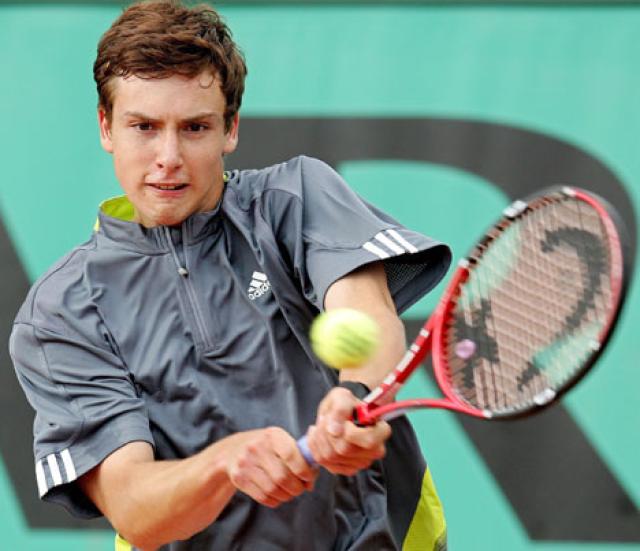
Ernests Gulbis
 Latvia
- Family and early tennis
- A rapid arrival on tour
- The defining season: 2014
- Injuries, resurgence and retirement
- Controversies and public image
- Life after the tour
- Legacy
Ernests Gulbis became the first Latvian man to break into the world’s top ten in singles, a rise powered by fearless shot-making and a career that rarely moved in a straight line. He reached the French Open semifinals, defeated Roger Federer on the way, and won six ATP Tour singles titles. Injuries and uneven seasons later pulled him far from the heights of 2014, but he remained involved in tennis after retiring, first through federation leadership and youth development and, in late 2026, as a coach.
Family and early tennis
Gulbis was born in Riga on 30 August 1988. He grew up in a family with strong sporting and artistic connections: his father, Ainars, is an investment businessman and former basketball player, while his mother, Milena, is a theatre actress. His paternal grandfather, Alvils Gulbis, played basketball for Latvia and the Soviet Union and won a European championship.
His grandmother introduced him to tennis when he was five. At twelve, he moved to Munich to train at the academy of former player Niki Pilić, remaining there until he was eighteen. Novak Djokovic also trained at the academy during that period. Gulbis was on the professional development track early, entering a Futures tournament at fifteen and winning his first titles on that circuit in 2005 and 2006.
A rapid arrival on tour
Gulbis made his ATP Tour main-draw debut in St Petersburg in 2006, reaching the semifinals as a wild card. The next season he broke into the top 100 and made his first Grand Slam appearances. At the 2007 US Open, he reached the fourth round after beating top-ten player Tommy Robredo, a result that announced him as one of the most promising young men in the game.
His first major breakthrough came at the 2008 French Open, where he reached the quarterfinals and lost to Djokovic. He added another milestone in 2010, winning his first ATP title at Delray Beach and then defeating world No. 1 Federer at the Rome Masters before falling to Rafael Nadal in the semifinals. Gulbis could produce spectacular wins against the very best, but his progress was interrupted by injuries and inconsistent stretches.
The defining season: 2014
In 2014, Gulbis found the most sustained form of his career. He won titles in Marseille and Nice, beating top-ten opponents Richard Gasquet and Jo-Wilfried Tsonga in Marseille. At the French Open, he defeated Federer in a five-set fourth-round match and then beat Tomas Berdych to reach his first Grand Slam semifinal. Djokovic stopped him there, but the run lifted Gulbis to a career-high ranking of world No. 10 in June.
The results made him the first Latvian man to reach the top ten and the first from his country to reach a Grand Slam semifinal. The season also cemented his reputation as a dangerous, unpredictable opponent: his serve, two-handed backhand and deft drop shots could overwhelm elite players, while his aggressive style also brought a high number of unforced errors.
Injuries, resurgence and retirement
Shoulder and wrist problems began to affect Gulbis after his peak season. His ranking fell sharply, but he produced a striking return at Wimbledon in 2017, reaching the third round as world No. 589. In 2018, he qualified for the main draw and made the fourth round, beating Alexander Zverev in five sets before losing to Kei Nishikori. Later that year, he reached the Stockholm final.
He won another Challenger title in Pau in 2020 and made the third round of the Australian Open, but pandemic disruption and further loss of form prevented a sustained return to the top level. His last official match came for Latvia in the Davis Cup in February 2023. He formally ended his playing career in 2024, after six ATP singles titles and a career-high ranking of No. 10.
Controversies and public image
Gulbis became known for outspoken press conferences as well as his results. In 2009, Swedish police detained two foreign tennis players on suspicion of soliciting sex; their names were not released at the time. Gulbis later discussed his own overnight detention in Stockholm, saying he had been fined and kept in custody for six or seven hours. He spoke sarcastically about the incident and described his time in jail as amusing.
At the 2014 French Open, after being asked whether he wanted his younger sisters to become professional players, he said he hoped they would not, arguing that women needed to think about family and children. The comments drew criticism and responses from players including Maria Sharapova, who said women had different opinions and that she thought he was joking. The episode became one of the most widely reported examples of his provocative public style.
Life after the tour
While still active, Gulbis was elected president of the Latvian Tennis Union in 2022. He said he wanted to help young players avoid mistakes he felt he had made, emphasizing access to qualified coaching and junior development. He resigned in August 2025, saying he and the federation’s secretary general planned to devote their work to a tennis academy and youth training. He also established a tennis school and a foundation intended to give talented children access to their first training.
In November 2026, Gulbis returned to the professional circuit in a new role, beginning work as coach of Kazakhstan’s Alexander Shevchenko. After a career defined by dramatic breakthroughs and setbacks, his next chapter keeps him close to the sport while he helps guide another player through the tour he once navigated himself.
Legacy
Gulbis’s peak remains a landmark in Latvian tennis: a top-ten ranking and a major semifinal once seemed out of reach for the country’s men’s game. His talent made him capable of beating champions on the biggest stages, and his later comeback runs showed the resilience behind that flair. His blunt, sometimes controversial public comments also became part of his profile, making him one of tennis’s more memorable personalities of his generation.