Ernst Ganfshtengl
 Germany
Biography of Ernst Hanfstaengl
Ernst Franz Sedgwick Hanfstaengl, also known as "Putzi," was born in Munich in 1887 to a mixed American-German family. His father was a well-known art dealer. Hanfstaengl attended the Bavarian Wilhelmsgymnasium, where his class mentor was the father of Heinrich Himmler. However, instead of taking over the family business on 5th Avenue in New York City, Hanfstaengl was sent to Harvard University in 1905, which he graduated from in 1909. During World War I, he remained in the United States and was disappointed in his inability to serve his ancestral country during the crisis. After the war, he returned to Munich, where he found the country in a state of complete collapse.
Unofficial Court Jester
Hanfstaengl found himself in the company of Adolf Hitler, a towering giant with an enormous head, bulging jaw, and thick hair, and accepted the nickname "Putzi." He was a talented pianist and skillfully performed works by Liszt and Wagner, despite his large hands. In the political chaos of Munich in the early 1920s, Hanfstaengl inexplicably developed sympathy for Hitler, who was still an unknown aspiring politician. As the only literarily gifted person in Hitler's circle, Hanfstaengl introduced the ignorant Austrian to Munich's artistic and cultural circles. After the suppression of the Beer Hall Putsch in 1923, Hitler found temporary refuge at Hanfstaengl's villa in the Bavarian Alps. Hanfstaengl visited Hitler in Landsberg Prison and helped him recover after his release. Both before and after the Nazis came to power, Hanfstaengl remained among Hitler's closest circle. He was a cheerful and amusing companion during political campaigns, seen as a Shakespearean jester capable of providing relaxation to the exhausted leader. Hanfstaengl never stopped talking. As a reward for this, he was appointed as the foreign press secretary of the NSDAP. In this position, which he held until leaving Germany, Hanfstaengl sought to benefit the Nazi movement through his numerous influential friends abroad.
The Cooling Relationship with Hitler
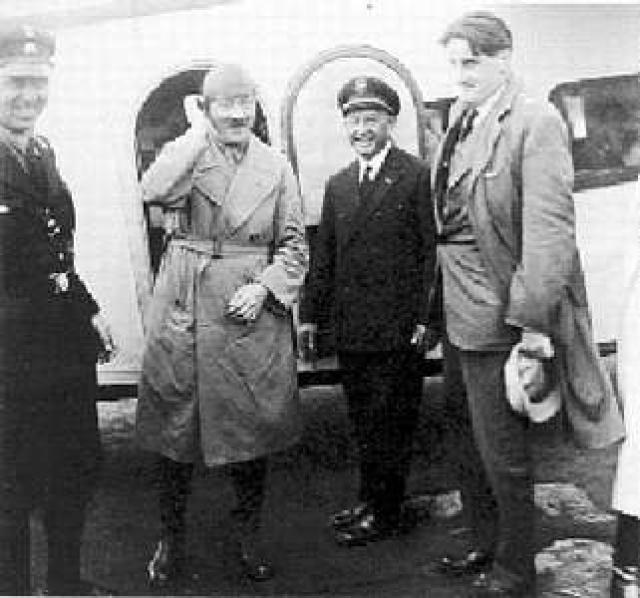
By the end of 1934, the relationship between Hitler and Hanfstaengl noticeably cooled. Putzi tried to delicately influence the Führer to temper his political, religious, and racial views, while Hitler did not tolerate any interference in his affairs and became furious at the slightest objection. At one of the crowded receptions, Hanfstaengl publicly referred to Minister of Public Enlightenment and Propaganda, Dr. Goebbels, as a pig. Such frankness did not endear him to the Nazis. In March 1937, sensing an impending danger, Hanfstaengl fled Germany. Later, he learned that a plan had already been devised to eliminate him – he was going to be thrown out of the plane. On April 19, 1937, Göring wrote a letter to Hanfstaengl, assuring him that it had all been intended as a harmless joke: "We wanted to give you the opportunity to reconsider some overly audacious statements that you allowed yourself. Nothing more than that. I give you my word of honor that you can stay here among us, as you always have, completely free. Forget your suspicions and act wisely. I hope you will view my words favorably." Hanfstaengl was not inclined to accept Göring's "word of honor" and remained in exile. During World War II, Hanfstaengl served in the United States as an expert on Nazi affairs in the White House. After the war, he was interned but later returned to his homeland. In 1957, he published the book "Hitler: The Missing Years" in London. Hanfstaengl passed away on November 6, 1975, in Munich.