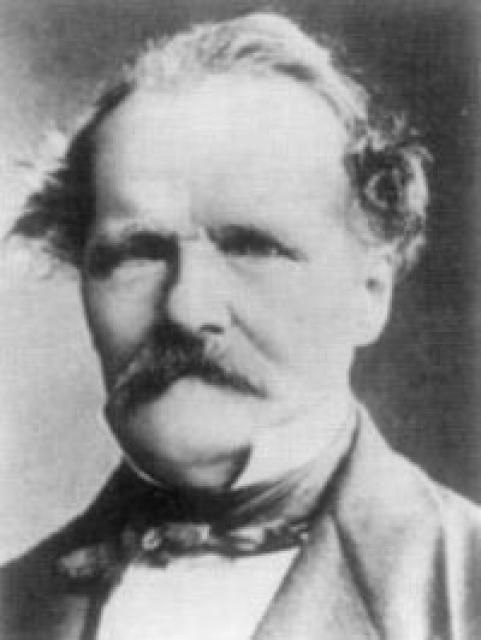
Ernst Kummer
 Germany
Biography of Ernst Kummer
Ernst Kummer was a German mathematician who made significant contributions to the fields of analysis, number theory, geometry, and theoretical mechanics. He was born in the Prussian town of Sorau (now Żary, Poland) in 1810. At a young age, Kummer lost his father, but thanks to the heroic efforts of his mother, he was able to receive an education.
In 1828, Kummer enrolled at the University of Halle, where he studied mathematics, theology, and philosophy. In 1831, he graduated from the university, and his doctoral degree was immediately awarded for one of his works on mathematical analysis.
After completing his studies, Kummer spent the next ten years teaching mathematics and physics at the Higher Gymnasium in Liegnitz (now Legnica). Among his students was Leopold Kronecker, with whom he maintained a lifelong friendship. During this time, Kummer gained recognition in the scientific community with several publications on hypergeometric series. In 1839, he was elected to the Berlin Academy of Sciences.
In 1840, Kummer married his cousin, and in 1842, he became a professor of mathematics at the University of Breslau (now Wrocław) upon the recommendation of his colleagues Peter Gustav Lejeune Dirichlet and Carl Gustav Jacob Jacobi.
Tragedy struck Kummer in 1848 when his wife passed away. In 1855, he moved to Berlin, where he taught at the University of Berlin. It was during this time that he assisted Karl Weierstrass in relocating to Berlin, establishing the Berlin Mathematical School as one of the leading institutions in Europe.
Kummer retired in 1890 and passed away three years later. Among his notable students, in addition to Kronecker, were renowned mathematicians Paul du Bois-Reymond, Paul Albert Gordan, Karl Gustav Adolf Schwarz, and Georg Cantor.
Kummer was elected as a foreign member of the Paris Academy of Sciences, the Royal Society of London, and the St. Petersburg Academy of Sciences in 1862. His contributions to analysis, the theory of algebraic numbers, geometry, and theoretical mechanics were highly influential.
In analysis, Kummer continued the work of Carl Friedrich Gauss on hypergeometric series. He is also known for his namesake convergence test.
In number theory, Kummer extensively studied Fermat's Last Theorem from 1837, and although he did not solve the problem, he proved it for a specific class of prime exponents. During his research, he made numerous valuable discoveries, such as ideal numbers and their unusual properties in 1846. For these works, he received the Grand Prix from the Paris Academy of Sciences in 1857.
Kummer also proved the law of reciprocity for all power residues with prime exponents. It would take several more decades for David Hilbert to make further progress in this area.



