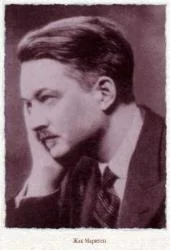
Ernst Laas
Ernst Laas was a German philosopher and educator whose work challenged the idealist tradition that dominated much nineteenth-century philosophy. Drawing on the empirical approach associated with Protagoras, he argued that knowledge should begin and end with observable facts. His three-volume study Idealism and Positivism set out this view in detail and made him a distinctive voice in debates about science, knowledge and ethics.
From Fürstenwalde to Berlin
Laas was born on June 16, 1837, in Fürstenwalde, Prussia. His family had modest means, but the support of General von Massow enabled him to attend the Joachimsthal Gymnasium in Berlin. After working as a private tutor, he studied theology and philosophy in Berlin, where he came under the influence of philosopher Friedrich Adolf Trendelenburg.
Laas completed a doctorate in philosophy with a dissertation on the moral principle of Aristotle. In 1861, he began teaching at the Wilhelms-Gymnasium in Berlin. His years as a schoolteacher shaped his interest in education, and he published several works on teaching and the organization of secondary schools.
Philosophy and positivism
In 1872, Laas became a full professor of philosophy at the University of Strasbourg. There he developed a systematic account of positivism, the view that knowledge should be grounded in experience and facts rather than abstract principles beyond experience.
His major work, Idealism and Positivism, appeared in three volumes between 1879 and 1884. Following Trendelenburg’s historical approach, Laas organized the history of philosophy around a central opposition: Platonic idealism, associated with timeless ideas, and the empirical or positivist outlook linked to Protagoras. Laas considered the latter more suitable for scientific inquiry because it treated experience as both the source and the limit of knowledge.
He also applied positivism to ethics. Rather than grounding moral principles in an absolute or otherworldly order, he emphasized their development within human society. This approach brought him into conflict with Christian ethics and prevailing views of morality and law.
Criticism of Kant
Laas’s engagement with Immanuel Kant was a central part of his work. In Kants Analogies of Experience, published in 1876, he closely examined Kant’s account of how the mind structures experience. He rejected the idea that pure reason could extend knowledge beyond what experience provides.
He returned to Kant in later writings on the historical conflict between faith and knowledge. His criticisms placed Laas within the nineteenth-century debate over whether philosophy could establish truths independent of the empirical sciences.
Legacy
Laas died in Strasbourg on July 25, 1885, at the age of 48. His writings on positivism, Kant and pedagogy continued to attract scholarly attention after his death. Though less widely known than some of his contemporaries, Laas offered a forceful alternative to idealism and helped shape the early development of German positivist thought.