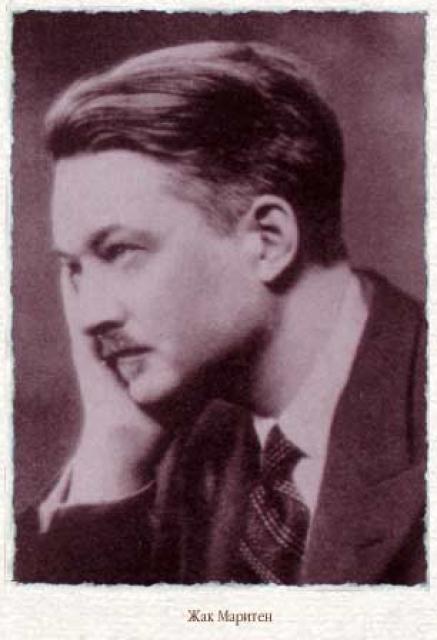
Mariten Jacques
 France
Biography of Jacques Maritain
Jacques Maritain was a French religious philosopher who was born in Paris on November 18, 1882. He received a Protestant education and studied at the Sorbonne. He spent two years (1907-1908) at the University of Heidelberg, where he studied biology under the guidance of Hans Driesch. Maritain was a student of Henri Bergson and later, under the influence and example of Léon Blou, converted to Catholicism in 1906.
Maritain's work, one of the most well-known philosophers of the 20th century, was relatively unknown to Ukrainian readers. The fact that he belonged to the philosophical movement of neo-Thomism, the official doctrine of the Catholic Church, made it impossible for his works to be translated or studied seriously during the time of the USSR. It was not until the late 1980s that his monumental legacy began to be explored, with the complete collection of his works published in 13 volumes.
As a systematic philosopher, Maritain covered all major areas of philosophy in his work: ontology, epistemology, ethics, aesthetics, philosophy of religion, philosophical anthropology, and social-political philosophy. His book "Man and the State" is based on six lectures he delivered in December 1949 as part of a course on the analysis of political institutions in the United States, organized by the Charles R. Walgreen Foundation. The book, like several of his other works from his "American" period, was originally written in English (first edition in 1951) and later translated into French by his secretary.
"Man and the State" is not only a theoretical treatise, but also a "practical manifesto." Maritain proposes a "concrete-historical ideal" for the "new democracy." Inspired by the principles of Thomism, he sought to apply them in the cultural and political context that emerged after World War II. Fifty years later, some of Maritain's ideas, such as the concept of a "world government" composed of the "wisest and most morally upright representatives of each nation," may seem somewhat naive. However, the depth of his analysis and the passion of his humanism have never wavered.
Maritain's social-philosophical doctrine inherits numerous concepts and ideas, starting from Plato's "Republic" and including Enlightenment ideals and the research of the Chicago School of Sociology. He was directly influenced by thinkers such as Henri Bergson, Emmanuel Mounier, and Nikolai Berdyaev. In his book "Man and the State," Maritain begins with an analysis of the often contradictory relationships between the categories he seeks to use to understand the complex fluidity of social reality. These categories include "nation," "political society," "state," and "people."
The stages of historical development are presented in a dialectical relationship, sometimes normal, sometimes distorted, between "community" (a social phenomenon of a natural type) and "society" (a phenomenon of contractual organization). According to the philosopher, the normative role of "society" is to promote the natural development of the "community" with minimal intrusion and control, promoting the maximum expression of pluralism, personal freedom, and initiative. This constant interaction between "community" and "society" implies that sovereignty can only be relative or comparative, and not absolute, whether in the sphere of public autonomy or state power.
These foundational principles of politics are further refined through the analysis of contemporary society in chapters dedicated to power, the relationship between means and ends, human rights, democratic law, the church and the state, and political unity of the world. The diversity of cultures, ideologies, and religions, not to mention the interests and claims that arise when dealing with international problems, lead Maritain to distinguish pragmatic rules of action that can be adopted by practical reason in a fluid and changing world, from doctrinal-theoretical justifications of these rules. Differences in interpretation do not eliminate the possibility of consensus at the level of concrete actions.
Ultimately, Maritain believed that only religion and the church are capable of regulating relationships between individuals and groups at the highest spiritual level. He saw the solution to the crisis of his era in the affirmation of "theocentric humanism," "personalist democracy," the Christianization of all areas of spiritual culture, and the ecumenical convergence of religions. Maritain's socio-cultural ideal received official recognition from the Catholic Church after the conclusion of the Second Vatican Council (1962-1965).