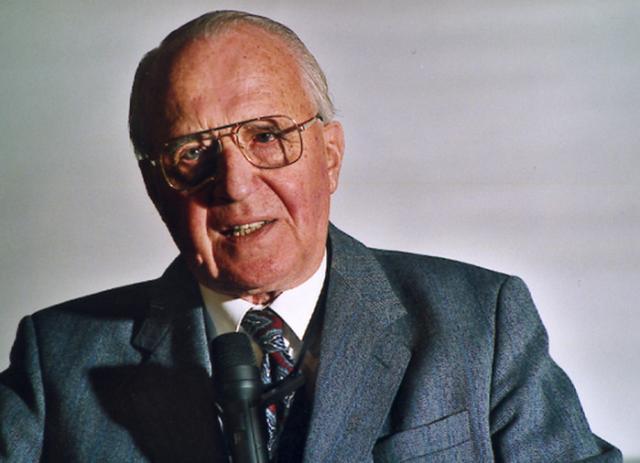
Ernst Otto Fisher
 Germany
Biography of Ernst Otto Fischer
Ernst Otto Fischer, a German chemist and recipient of the Nobel Prize in Chemistry in 1973, was born in Soln, a suburb of Munich. He was the youngest of three children of Karl Tobias Fischer, a professor at the Physical Institute of the Munich Technical University, and Valentina Fischer (née Dancer). Fischer received his education first at a local school, then at the Theresa Gymnasium and Technical School in Munich.
After completing his education in 1937, he was called up for two years of military service in the German army and served in Poland, France, and the Soviet Union during the onset of World War II. He spent six months as a prisoner of war in the United States and was liberated in 1945. When the Munich Technical University reopened in 1946, Fischer resumed his research, working in collaboration with Walter Hieber, a pioneer in the study of metal carbonyls (metals chemically bonded to molecules containing carbon and oxygen).
In 1952, Fischer obtained his doctorate in Munich and remained there as a research assistant. In his dissertation, written in 1951 and dedicated to metal carbonyls, Fischer conducted a detailed analysis of the structure of ferrocene, also known as dicyclopentadienyliron. Prior to Fischer, chemists T. G. Kealy and P. L. Pauson had discovered ferrocene and found that it contained two five-membered rings of hydrogen and carbon atoms linked to a central iron atom. According to prevailing theories at the time, such molecules were expected to be extremely unstable, but in reality, ferrocene exhibited exceptional chemical and thermal stability. Fischer set out to explain this anomalous phenomenon.
His initial investigations into the stability of ferrocene led him to believe that Kealy and Pauson had been mistaken in assuming that the two cyclopentadienyl rings of ferrocene lay in the same plane and were connected to the central iron atom by a relatively weak bond. Fischer described ferrocene as a "completely new type of covalent complex." Using X-ray structure analysis, Fischer determined that the two rings were parallel, stacked like layers, or in a sandwich-like arrangement with the iron atom in the center. As a result, the central metal atom was bonded to each of the five carbon atoms in the upper and lower rings. This explained the high stability of the molecule and led to the discovery of a new class of compounds.
In further experiments, Fischer confirmed the existence of other molecules with a similar structure. Upon Walter Hafner's suggestion, Fischer synthesized chromocene, which consisted of two parallel benzene rings connected by a central chromium atom. Most chemists believed that such a molecule could not be created. Fischer continued his research with transition metals, particularly focusing on metal complexes with arenes (aromatic hydrocarbons). In 1954, Fischer became an assistant professor at the Munich Technical University. Three years later, he became a professor of inorganic chemistry at the Institute of Inorganic Chemistry at the Munich Technical University. He also served as a visiting professor, delivering lectures at the universities of Jena, Marburg, and later the University of Wisconsin-Madison.
In 1964, Fischer succeeded Walter Hieber as the director of the Institute of Inorganic Chemistry at the Munich Technical University, where he created excellent conditions for X-ray structural and spectroscopic research on molecular structures. His laboratory soon became a leader in metal-organic chemistry research. Interested in in-depth research and the efficiency of science, Fischer frequently spoke on these topics both within the Institute of Inorganic Chemistry and during lectures abroad, including at the University of Florida (1971) and the Massachusetts Institute of Technology (1973). In 1973, Fischer shared the Nobel Prize in Chemistry with Geoffrey Wilkinson for their independent groundbreaking work on the chemistry of metal-organic, or so-called sandwich, compounds. In his presentation speech, Indvar Lindqvist, a member of the Royal Swedish Academy of Sciences, stated that "the discovery and proof of new principles of bonding and structures in sandwich compounds are a significant achievement" whose practical implications are still impossible to predict at present.
Fischer's work laid the foundation for the development of new catalysts used in various industrial processes, including the production of pharmaceutical agents and low-lead fuels. From that point on, he began researching carbene complexes of transition metals, which led to the emergence of new classes of metal-organic compounds. Fischer was attentive to his colleagues and students, considerate and friendly, and he was an inspiring teacher. In his free time, he taught a course on history. He never married.
In addition to the Nobel Prize, Fischer received the Chemistry Prize from the Göttingen Academy of Sciences (1957) and the Alfred Stock Memorial Award from the German Chemical Society (1959). He was an honorary member of the American Academy of Arts and Sciences and many other scientific societies. He also held honorary titles from the universities of Munich, Erlangen, and Nuremberg.


