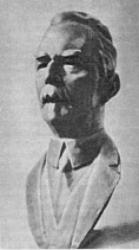
Eugen Kogon
 Germany
- Eugen Kogon: A German Intellectual and Auschwitz Survivor
- Journalistic Career and Opposing Nazism
- Life in Buchenwald and Resistance
- Post-War Career
- Academic and Literary Contributions
- Legacy and Honors
Eugen Kogon: A German Intellectual and Auschwitz Survivor
Early Life and EducationEugen Kogon was born in Munich, Germany, on November 23, 1903, to a Jewish father and a Catholic mother. His father was a Russian diplomat, and the family lived in a Catholic monastery during Eugen's childhood and adolescence.
Kogon studied economics and sociology at universities in Munich, Florence, and Vienna. He completed a diploma thesis on fascist corporate theory in Vienna in 1927.
Journalistic Career and Opposing Nazism
In 1927, Kogon began working as a journalist in Vienna, editing the Catholic magazine "Sch?nere Zukunft." He became increasingly critical of Nazism in the 1930s and joined the active opposition in 1936.
In 1937, the Gestapo put Kogon under surveillance. After the outbreak of World War II in September 1939, he was arrested and sent to the Buchenwald concentration camp as prisoner number 9093.
Life in Buchenwald and Resistance
In Buchenwald, Kogon became the secretary to Dr. Erwin Ding-Schuler, who conducted experiments on prisoners, including with typhus. Using his position, Kogon reportedly helped and saved many victims of Nazism, including Stéphane Hessel and two British intelligence officers, whose numbers he changed to those of prisoners who had died of typhus.
Kogon's name was included in an SS list of 46 people to be executed upon the arrival of Allied forces. However, he escaped execution when Ding-Schuler removed him from the camp before its liberation.
Post-War Career
After World War II, Kogon played a significant role in the consolidation of Christian democracy in Hesse. He helped draft the "Volks Partei Program," which influenced the Constitution of Hesse and advocated for "economic socialism on a democratic basis."
From 1946, Kogon published the left-wing Catholic journal "Frankfurter Hefte" with Walter Dirks, which reached a circulation of 75,000 copies. However, he later clashed with the leadership of the Christian Democratic Union, criticizing Adenauer's policies, rearmament, and nuclear weapons.
Academic and Literary Contributions
From 1951 to 1968, Kogon was a professor of political science at the Technical University of Darmstadt. He was a vocal advocate of European federalism and welcomed the reconciliation of West Germany with Poland, the USSR, and Czechoslovakia under Willy Brandt's "Ostpolitik."
Kogon became widely known for his book "The SS State: The System of German Concentration Camps" (1946), the first major study of the social structure of Nazi concentration camps. The book remains an authoritative work on the subject and has been translated into numerous languages.
Legacy and Honors
Kogon's contributions to democracy and historical understanding have been recognized with the establishment of the Eugen Kogon Prize in 2002. The prize is awarded annually for outstanding contributions to democratic values, with notable recipients including Polish Foreign Minister Władysław Bartoszewski and Stéphane Hessel.
A street in Königstein bears Kogon's name, and a commemorative plaque is installed at Buchenwald in his honor.