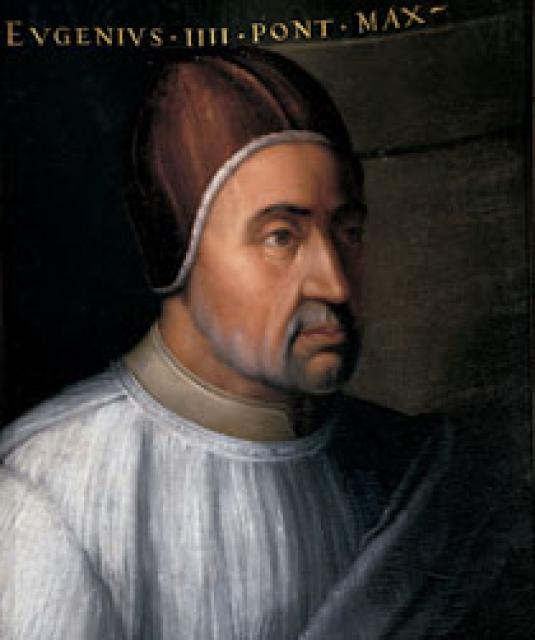
Eugenius IV
 Italy
Italy- Papacy and Background
- Early Life and Career
- Conflict with the Cardinals
- The Council of Basel
- Exile and Rise of Antipope Felix V
- Florence and the Union with the East
- Diplomacy and Conflict
- Patron of the Arts
- Death and Legacy
Papacy and Background
On March 3, 1431, Gabriele Condulmer ascended to the papacy as Pope Eugene IV, a position he held until his death on February 23, 1447. Born into a noble Venetian family in 1383, Condulmer was the nephew of Pope Gregory XII, who abdicated at the behest of the Council of Constance.
Early Life and Career
As a young man, Condulmer joined the Augustinian hermits. Influenced by his uncle, he became the bishop of Siena and was later elevated to the rank of cardinal. During the conclave that elected Eugene IV, he was forced to sign an agreement limiting his power in matters of cardinal appointments and major ecclesiastical decisions. The cardinals also gained control over papal finances.
Conflict with the Cardinals
Despite these restrictions, Eugene IV proved to be a resolute leader. He revoked the conditions imposed upon him and set out to curtail the privileges granted to cardinals by his predecessor, Martin V. This move drew much opposition, leading to riots in Rome by supporters of the Colonna family.
The Council of Basel
Eugene IV initially dissolved the Council of Basel, convened on July 23, 1431. However, after protests from the attending bishops, he recognized its legitimacy. The council's efforts to assert its authority over the papacy, known as conciliarism, put him in conflict with its proponents.
Exile and Rise of Antipope Felix V
In 1434, Eugene IV was forced to flee Rome following an uprising supported by the Colonna family. He sought refuge in Florence, where he continued to rule the Church with the assistance of the Medici. The council, ignoring Eugene's authority, deposed him and elected Amadeus of Savoy as the antipope Felix V.
Florence and the Union with the East
Eugene IV convened his own council in Ferrara, later moved to Florence. In 1439, the council proclaimed the union of the Latin and Greek churches. This union, however, faced little support among the Eastern clergy.
Diplomacy and Conflict
Eugene IV strengthened the relationship between the Holy See and the Grand Duchy of Moscow. He organized the unsuccessful Crusade of Varna against the Ottomans in 1444. His pro-German policies alienated France, leading to the Pragmatic Sanction of Bourges, which asserted the supremacy of the French Church over the papacy.
Patron of the Arts
Despite spending much of his reign in Florence, Eugene IV made significant efforts to restore Rome to its former glory. He invited many prominent humanists, artists, and musicians to the city.
Death and Legacy
Eugene IV died a troubled figure, reportedly lamenting his departure from his monastic life. Nonetheless, he contributed significantly to the unity of the Church. Despite his shortcomings, including his lack of experience and indecisiveness, he was a man of integrity and devotion. He reformed monastic orders, supported education, and is remembered as a patron of the arts. His tomb is located in San Salvatore in Lauro in Rome.


