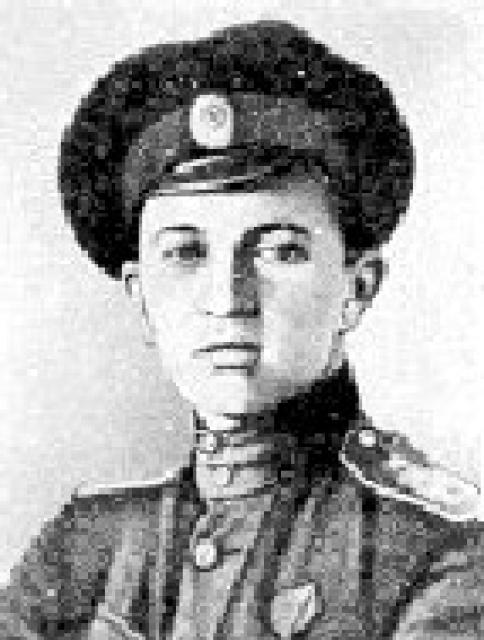
Evgraf Kruten
 Ukraine
Biography of Evgraf Kruten
Evgraf Nikolaevich Kruten was born on December 17, 1892, in Kiev. He received his education at the Kiev Cadet Corps and graduated from the Konstantinov Artillery School before being assigned to the 4th Cavalry-Artillery Division. In the summer of 1913, Lieutenant E. N. Kruten was sent as an observer to the autumn maneuvers of the Kiev Military District. It was during this time that he joined the 11th aviation squadron, commanded by Staff Captain P. N. Nesterov. Kruten flew with him on reconnaissance missions and artillery fire correction and witnessed the world's first "dead loop" performed by Nesterov. Inspired by this experience, he decided to become a pilot.
Upon Nesterov's recommendation, Kruten enrolled in the Gatchina Military Aviation School and graduated with a first-class rank in 1914. The outbreak of World War I showcased Kruten's combat skills in aerial battles on the Western Front. On August 23, he performed two Nesterov loops on a two-seat "Farman-20" and was subsequently assigned to the 21st Corps Aviation Squadron on October 27. Flying a two-seat "Voisin" aircraft, Kruten successfully carried out reconnaissance and bombing missions. In early 1915, he organized the first-ever group night flight in aviation history to gather valuable information about enemy positions and direct artillery fire. Despite his efforts, he was unable to shoot down enemy aircraft as they often escaped due to their higher speed. This led Kruten to conclude that fighter aviation squadrons were needed to combat enemy aircraft, and he requested permission to create such a unit.
On May 24, 1916, Kruten received an order from the Military Air Fleet Command: "Captain Kruten, commander of the 2nd Army Aviation Squadron, is appointed commander of the 2nd Fighter Aviation Squadron" (in 1916, 12 such units were being created in Russia). With extraordinary energy, Evgraf Nikolaevich set about forming the squadron and training its pilots in aerial combat. The squadron had single-seat "Nieuport-XI" aircraft with a speed of up to 150 km/h and was based near Brody. German pilots soon realized the formidable opponent they faced in this aviation group. Kruten, taking command, quickly built a strong combat unit and personally led his pilots into battle. On July 30, he achieved his first victory and emerged victorious from another duel two days later.
The combat activities of Kruten during those days are evidenced by an order from August 2, 1916, to the troops of the 2nd Army on the Western Front. It stated: "On August 1 of this year, around 7 pm, an enemy aircraft appeared over Nesvizh. Captain Kruten, commander of the 2nd Fighter Aviation Squadron, who had just shot down a German aircraft near Svoiatychi on July 30, immediately took off in his 'Nieuport' and caught up with the German, engaging in combat with him.
My staff and the entire city admired the brave duel of the two aircraft. Captain Kruten fiercely attacked the German, and after a short but extremely effective battle, shot down the German 'Albatros,' forcing the wounded pilot to land not far from the city. The population, who had eagerly followed the daring and skillful actions of our hero - the aviator, joyfully rushed out of the city to give him ovations. I express my heartfelt gratitude to Captain Kruten for his outstanding courage, determination, and valor in the fight against the enemy and order to present him with an award.
Army Commander, Infantry General Smirnov." In late November 1916, Evgraf Kruten, together with other front-line pilots - Orlov, Barkovsky, Sveshnikov, and Kezhun - were sent abroad to study the combat experience of the allies and master new types of aircraft. In France, he fought in Squadron No. 3 "Storks" of the air combat group of A. Brockard (GC 12). In a month of battles, flying from the airfields of Cachy (near Amiens) and Manoncourt (near Nancy), he shot down 2, or according to other sources, 3 enemy aircraft. Alongside engaging in aerial combat, Kruten also carried out ground attacks on enemy positions and performed reconnaissance flights. For his actions in France, he was awarded the "Combat Cross with Palm Branches."
The magazine "Iskry" wrote that Kruten astonished even his teachers with his incredible courage and developed the tactics of aerial attacks that later earned him a reputation as one of the best fighter pilots. Alongside Peter Nesterov, he can rightfully be considered one of the founders of fighter aviation tactics.
In March 1917, Kruten returned to Russia and on April 19, was appointed commander of the 2nd Combat Aviation Group, consisting of the 3rd, 7th, and 8th Corps Squadrons, on the Southwest Front. Each squadron had its own distinctive marking on the fuselage. The 3rd squadron had an Indian head, the 7th squadron had an eagle head, and the 8th squadron had an ace of hearts. Kruten enjoyed exceptional authority and affection within the squadron. He possessed remarkable piloting skills, combining bravery with high flying mastery. Soon, he achieved another victory by shooting down an Austrian reconnaissance aircraft, "Hansa-Brandenburg," and on May 24, he shot down another two "Fokkers" in a single flight. However, these victories were not officially confirmed as the battle took place over enemy territory.
Initially, Kruten flew the "Nieuport-17" aircraft with an 80 hp rotary engine, later switching to the "Nieuport-23" with a 120 hp engine. On its fuselage was painted the head of a Russian knight wearing an ancient helmet. In the hands of an experienced pilot like Kruten, this aircraft became a formidable weapon with a speed of up to 160 km/h. German and Austrian pilots feared him and often avoided combat even when they had numerical superiority.
Kruten's aerial combat tactics involved gaining an advantage in altitude and then attacking the enemy from the direction of the sun. Descending 50-100 meters below the enemy, Kruten would quickly climb back up and approach the enemy aircraft from below and behind, firing his machine gun from a distance of 10-15 meters.
The best pilots of Germany and Austria consistently suffered defeats in battles against him. For example, Oberleutnant Frank von Lincke-Crawford, a renowned Austrian ace with 30 victories by the end of the war, crossed swords with Kruten three times and, as the Austrian himself writes, was forced to "go down" (land) each time to save his life. On the Eastern Front, Kruten had no equals. Modest and even ascetic in his personal life, Evgraf Nikolaevich demonstrated courage and resourcefulness in combat. His character was characterized by a sense of military duty and compassion towards his opponents.
Once, Kruten landed near a downed enemy aircraft in the hope of providing assistance to the enemy pilot. However, he discovered that the pilot was already dead. Among the documents of the deceased, Kruten found a photograph: a brave pilot with his wife and son. The idyllic family scene touched the heart of the Russian aviator. At that time, it was customary to inform the enemy about the fate of their downed pilots whenever possible. Flying over the German aerodrome, Kruten dropped a package containing the photo and a note: "I regret the loss of your husband and father, but war is war: if it wasn't me, it would have been him..."
While most fighter pilots did not have well-defined methods of combat at the time, Kruten had his own tactics and methods that yielded excellent results. He was not only a master of skill, courage, and composure but also a pioneer in the scientific foundations of aerial combat. Believing that the duty of fighter aviation was to "destroy the enemy in the air wherever they could be found," the pilot developed over 20 ways to attack single, paired, and group aircraft. Kruten was the first to recommend flying in pairs, considering them the most effective tactical unit. He authored nine works on fighter aviation tactics.
According to various sources, Evgraf Kruten destroyed between 7 and 17 enemy aircraft in aerial combat (including unofficial victories) and was awarded several orders and the Order of St. George. Once, Kruten protected a spotter aircraft. Running out of fuel at an altitude of 3000 meters, he began gliding towards his airfield but encountered a German aircraft. Without hesitation, he engaged and shot down the enemy, even though his tanks were completely empty.
On June 6, 1917, while landing without a drop of fuel on his airfield near the village of Plotychi, close to Tarnopol, Captain Kruten made a sharp turn at a low altitude and, entering a spin, crashed. On that day, while defending a reconnaissance aircraft, "Voisin," from the attack of three Austrian fighters, Kruten shot down his final "Fokker."
"After the great Nesterov," the newspapers wrote, "he was the most prominent among the combat pilots. Kruten, who perished at the young age of 27..." Numerous versions have been put forward to explain the tragedy: a complete failure of the damaged aircraft's control system or a worn-out engine... As recalled by former pilot of the 2nd Fighter Aviation Group, I. K. Spatarel, "Kruten most likely perished because he was seriously wounded and lost consciousness in the air. After all, even in the case of engine failure, he could have landed the aircraft at any moment. Evgraf Kruten was, as aviators say, a pilot under God's mercy..."
It is difficult to argue with such an assessment given by an experienced aviator. However, this is just another version.