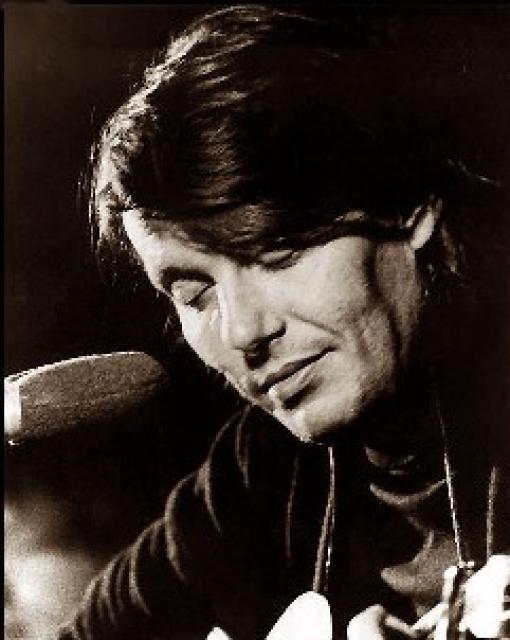
Fabrizio Cristiano De Andre
 Italy
ItalyBiography of Fabrizio Cristiano De André
Fabrizio Cristiano De André was an Italian singer-songwriter and poet. He explored themes of love, struggle, and the lives of prostitutes and outcasts in his work.
Born in Genoa on Via De Nicolay, 12, De André grew up in a family belonging to the upper levels of the industrial bourgeoisie. His father, Giuseppe, was the vice-mayor of Genoa and the general director of Eridania Zuccherifici Nazionali, Italy's largest sugar production and sales company. According to family legend, De André was born to the sounds of Gino Marinuzzi's composition "Country Waltz" playing on a gramophone. Twenty-five years later, De André would write his own "Waltz in Honor of Love" to the melody of Marinuzzi's composition.
During the war, De André's family sought refuge on a farm near Revignano d'Asti in Piedmont. His father, who was an anti-fascist and wanted by the police, joined the partisan resistance. In 1945, the family returned to Genoa, where De André attended elementary school. He first went to the School of the Sisters of Markellina, and later to the Cesar Battisti School. He then enrolled in the law faculty at the University of Genoa but did not complete his studies, leaving when he had only a few exams left.
De André had a strong musical inclination. He played the cello and later the guitar, and performed with several jazz bands. Jazz became his "first love."
First Recordings
In October 1961, De André released his first record, a 45 rpm single, on the Karim label. The album featured two compositions, "Nuvole barocche" (Baroque Clouds) and "E fu la notte" (And the Night Came). In 1962, De André married Enrica Rignon, a Genoese woman from a bourgeois family who was ten years older than him. That same year, their first and only son, Cristiano, was born. Cristiano followed in his father's footsteps and became a musician and songwriter.
In the following years, De André wrote songs that made him known to a wider audience and quickly became hits, such as "La guerra di Piero" (Piero's War), "La ballata dell'eroe" (The Ballad of the Hero), "Il testamento di Tito" (Tito's Testament), "La ballata del Miche" (The Ballad of Miche), "Via del Campo" (Via del Campo, a famous street in Genoa), "La canzone dell'amore perduto" (The Song of Lost Love), "La citta vecchia" (The Old City), "Carlo Martello ritorna dalla battaglia di Poitiers" (Charles Martel Returns from the Battle of Poitiers), which he composed together with Paolo Villaggio, and "La canzone di Marinella" (Marinella's Song). In 1968, "Marinella" was recorded and sung by one of Italy's famous singers, Mina, making De André the most well-known "cantautore" or singer-songwriter.
In 1970, De André created "La buona novella" (The Good News), a conceptual album based on an apocryphal story about the life of Christ. This album became very well-known, especially the song "Il testamento di Tito" (Tito's Testament), in which one of the bandits crucified alongside Christ fervently rejects the Ten Commandments. De André also composed a number of songs, such as "Preghiera in gennaio" (Prayer in January) and "Si chiamava Gesù" (His Name Was Jesus), which expressed thoughts close to Christianity. These songs, along with "Il testamento di Tito," were also sung in churches.
In 1971, De André wrote another concept album, "Non al denaro non all'amore né al cielo" (Neither Money, nor Love, nor Heaven), based on Edgar Lee Masters' book of poetry "Spoon River Anthology." The album was presented in an interview with Fernanda Pivano, the first Italian translator of the Anthology.
De André's name became associated with serious literature and poetry, and some of his songs found their way into school textbooks.
In 1989, De André entered into a legal marriage with Dori Ghezzi. The following year, he released a new album, "Le nuvole" (The Clouds), which included two songs in the Genoese dialect, one in the Gallurese or North Sardinian dialect, "Monti di Mola" (Mountains of Mola), and one in Neapolitan dialect, "Don Raffaè" (Don Raffaè). This was followed by a series of triumphant live concerts, resulting in the double album "1991 Concerti" (1991 Concerts).
In 1992, De André began another series of theatrical concerts, including the first-ever theater performances.
His last album, "Anime salve" (Saved Souls), was released in 1996. Co-written with Ivano Fossati, it became his "spiritual legacy." The album included the song "Khorakhane," dedicated to Muslim gypsies, "Disamistade," translated into English and performed by the American rock band The Walkabouts, and "Smisurata preghiera" (Boundless Prayer), based on the novellas from Álvaro Mutis' "Adventures and Misadventures of Maqroll the Gaviero." De André also performed the Spanish version of this song.
In 1997, De André began a new series of theatrical concerts, "Anime salve." A new compilation album of his songs, "M'innamoravo di tutto" (I Fell in Love with Everything), was released, containing some old compositions. The tribute album also included "La canzone di Marinella," performed as a duet with Mina.
During the summer of 1998, De André's "Anime salve" tour was interrupted due to the discovery of serious symptoms of an illness that was later diagnosed as lung cancer. Fabrizio De André passed away on January 11, 1999, at 02:30 in a Milan cancer institute. His funeral, held on January 13 in Genoa at the Basilica di Carignano, was attended by approximately 10,000 people, including friends, political figures, and cultural personalities. After cremation the following day, De André's ashes were buried in the family chapel at the Staglieno Cemetery.
In 2003, a tribute album dedicated to Fabrizio De André, "Faber, Amico Fragile," was released, featuring well-known Italian musicians, some of whom are also famous in Russia. For example, Adriano Celentano performed the song "La guerra di Piero" from this album.
A guitar belonging to Fabrizio De André is displayed in the window of a music store on Via del Campo.
In honor of Fabrizio De André, a special award was established, which was awarded to Gian Piero and Gianfranco Reverberi in 2007. De André's awards include the 1975 Premio Tenco (with five other singer-songwriters), the 1984 Targa Tenco for the album "Crêuza de mä" and the song of the same name as the best in dialect, the 1991 Targa Tenco for the song "La domenica delle salme" and the album "Le nuvole," and the 1997 Premio Lunezia for the song "Smisurata preghiera" and the album "Anime salve".


