False Dmitriy I
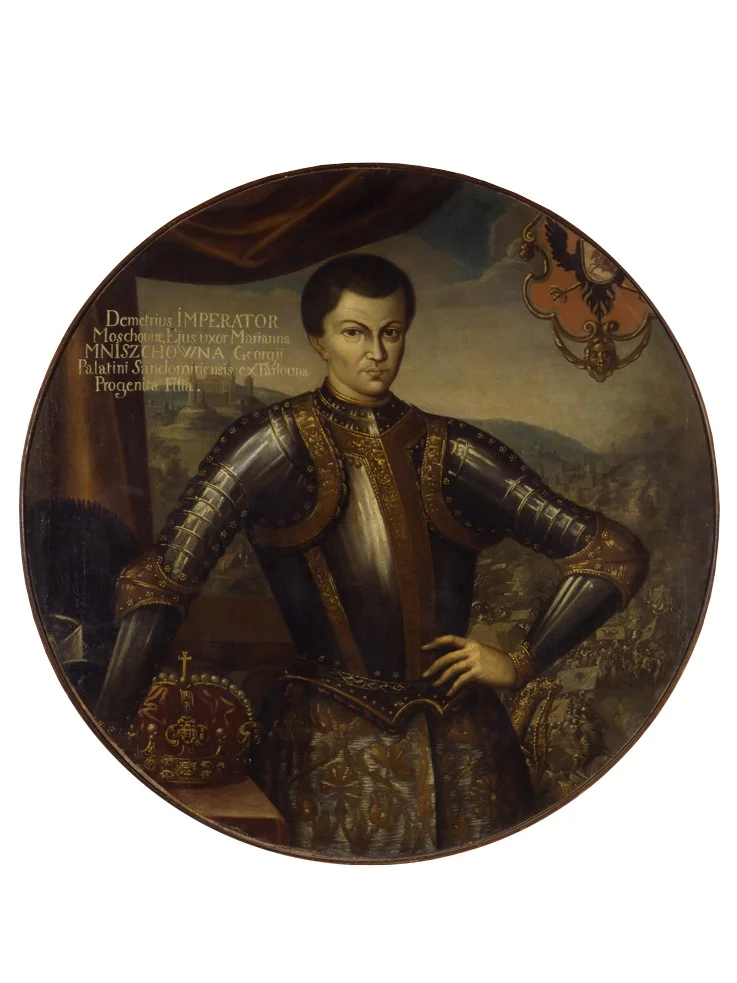
False Dmitry I was the most successful claimant to emerge during Russia’s Time of Troubles, the dynastic crisis that followed the end of the Rurikid line. In 1605 he entered Moscow and became tsar, insisting that he was Dmitry, the youngest son of Ivan the Terrible, who had supposedly died as a child. His true identity remains debated, though the Russian government of his day called him the runaway monk Grigory Otrepyev, and many historians consider that identification likely. His brief reign ended in a Moscow uprising that killed him and opened another chapter of the crisis.
A Claimant in a Dynastic Crisis
The real Dmitry, son of Ivan IV, died at Uglich in 1591 under circumstances that later became a source of suspicion and rumor. When Tsar Feodor, Ivan’s surviving son, died childless in 1598, the Rurikid dynasty that had ruled Russia for centuries came to an end. Boris Godunov, a former regent, was elected tsar, but his authority remained contested. Famine, social unrest, and the fragility of the new dynasty made the country receptive to claims that the dead prince had survived.
A young man appeared in the Polish-Lithuanian Commonwealth around 1603 and declared that he was Dmitry. According to his story, he had escaped an assassination attempt and lived in concealment. Moscow denounced him as Grigory Otrepyev, a monk who had fled his monastery and once served the Romanov family. The identification fit the government’s effort to discredit him, but the evidence is difficult to assess: much of it comes from hostile accounts written during the struggle for power. The claimant’s origins have not been established beyond doubt.
He gained support among Polish nobles and Russian opponents of Godunov. Some sponsors hoped to advance their own interests, while others supported the claim because they believed Dmitry was the rightful heir. He promised political and territorial concessions to win assistance, and he converted to Roman Catholicism while seeking backing abroad. His army crossed into Russia in 1604. The campaign initially faced resistance, but Boris Godunov died in April 1605, and the government’s forces began to defect. Godunov’s son Fyodor was overthrown, and the claimant entered Moscow in June.
Becoming Tsar
The new ruler was crowned in July 1605 as Tsar Dmitry Ivanovich. His accession was remarkable: a person whose birth and identity were disputed had displaced an elected monarch and entered the Kremlin as sovereign. He presented himself as a legitimate son of Ivan IV and sought to consolidate his authority through public appearances, court decisions, and gestures toward different social groups.
His rule was not simply an attempt to impose Polish Catholicism on Russia. Although he had accepted Catholicism in his dealings with foreign supporters, he did not try to convert the Orthodox population during his short reign. He appointed some foreigners to positions and pursued policies that unsettled powerful boyars, but he also acted independently of his sponsors. His energy, direct manner, and unfamiliar customs made him memorable to observers, yet they did not overcome the doubts surrounding his legitimacy.
The Polish noblewoman Marina Mniszech, daughter of one of his principal supporters, became central to the alliance. The couple married by proxy in 1605, and Marina arrived in Moscow in May 1606. Her Polish retinue and her refusal to adopt Russian Orthodox practice sharpened resentment among many Muscovites. Critics feared that the new ruler would privilege foreign interests and weaken the Orthodox church, even though his actual policies were more complicated than those charges suggested.
Overthrow and Death
A conspiracy led by Prince Vasily Shuisky exploited the tension surrounding Marina’s arrival and the presence of Polish guests. On May 17, 1606, Moscow erupted in revolt. The conspirators killed Dmitry and installed Shuisky as tsar. Marina and her father were arrested, while the official account of the uprising declared that the dead ruler had been an impostor.
His death did not end the claim. Supporters continued to insist that Dmitry had survived, and a second pretender later appeared. Marina herself would eventually recognize another claimant as her husband, helping extend the political life of the name beyond the first ruler’s death. Such stories show how deeply the possibility of a surviving tsarevich had entered popular and political imagination.
Legacy
False Dmitry I’s brief reign exposed the weakness of a monarchy whose legitimacy depended on dynastic inheritance. His rise drew support from people with very different aims: Polish nobles seeking influence, Russian boyars opposing Godunov, and subjects who hoped the lost prince had returned. His fall showed how quickly that coalition could fracture when his foreign alliances, personal choices, and claims collided with local expectations.
He remains one of the most enigmatic rulers of the Time of Troubles. Whether he was Grigory Otrepyev or another man, he persuaded enough Russians and foreign allies to help him take the throne. His success made the claim of the returned Dmitry a lasting political force, and his short reign helped set the stage for years of rival tsars, foreign intervention, and civil conflict before Russia reached a new settlement under the Romanovs.