Fedor Brandt
 Germany
- Friedrich Brand: German-Russian Naturalist and Zoologist
- Scientific Career in Berlin
- Arrival in Russia and Museum Development
- Academic Accomplishments and Expeditions
- Expedition to the Arctic and Paleontological Research
- Legacy and Family
Friedrich Brand: German-Russian Naturalist and Zoologist
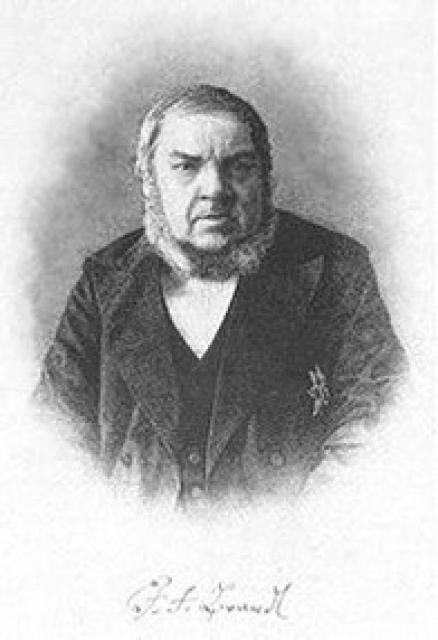
Early Life and EducationFriedrich Brand, renowned German-Russian naturalist, zoologist, and botanist, was born in Jüterbog, Prussian Saxony. He received his early education at the Gymnasium in his hometown and later at the Lyceum in Wittenberg. In 1821, Brand commenced medical studies at the University of Berlin under the tutelage of eminent professors such as Rudolf, Kluge, Hufeland, Rust, and Graefe. Initially pursuing botany under Heine's guidance, he expanded his interests to zoology and anatomy instructed by Lichtenstein and Rudolphi, under whom he served as an assistant. In 1824, Brand earned his doctorate in medicine and surgery.
Scientific Career in Berlin
Brand's scientific and pedagogical journey began in Berlin, where he worked as an assistant to Heim, a therapist. Within nine months, he transitioned to the position of assistant at the anatomical museum. In 1826, he completed his medical studies and received his Doctor of Medicine degree. From 1828 to 1831, Brand was a private lecturer at the medical faculty of the University of Berlin, becoming a full professor in 1831.
Arrival in Russia and Museum Development
Unable to secure a permanent position in Germany, Brand was influenced by Alexander von Humboldt and Karl Rudolphi to relocate to Russia. In 1831, he arrived in St. Petersburg and became an assistant to Karl Baer at the Zoological Museum of the Imperial Academy of Sciences, which he soon headed. Brand dedicated himself to developing the Zoological Museum, enriching its collection through expeditions and exchanges.
Academic Accomplishments and Expeditions
In 1832, Friedrich Brand was elected an extraordinary academician and in 1833 an ordinary academician of the Imperial Academy of Sciences. He served as an inspector at the St. Petersburg Mariinsky Institute (1837-1846) and as a professor of zoology and comparative anatomy at the Main Pedagogical Institute (1843-1850). Later, he taught at the Medico-Surgical Academy (1857-1869).
Expedition to the Arctic and Paleontological Research
Brand was recognized as a notable paleontologist of his time. He investigated fossil animals of various ages and types, except for mollusks. He dedicated special attention to fish, birds, whales, and extinct Pachydermata, including mammoths and rhinoceroses. Brand participated in the expedition of the Russian Geographical Society from 1846 to 1850, led by E.K. Hofmann. Despite health issues, he contributed a substantial article to the collective report published in 1856.
Legacy and Family
Friedrich Brand passed away on July 3, 1879 (July 15, Gregorian calendar), in Merreküll, near Narva. He was buried at the Smolensky Lutheran Cemetery in St. Petersburg. Brand's legacy extends through his sons: Alexander, a professor of zoology; Roman, a Slavist and professor at Moscow University; and Vladimir, an architect and professor. His daughter, Maria, married Gustav Radde, a famous explorer and naturalist.