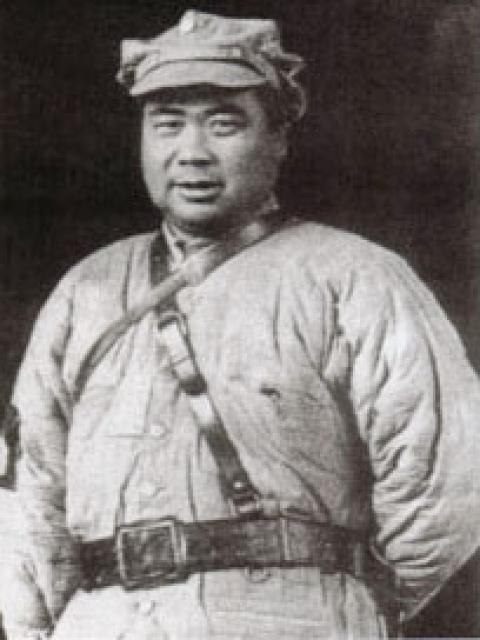
Fen Yuysyan
 China
China- Feng Yuxiang: The Christian General and Chinese Military Leader
- Experience Abroad and Return to China
- Rise to Power and Governing Philosophy
- Political Maneuvers and Alliances
- Military Campaigns and Political Influence
- Opposition to Japan and Later Years
Feng Yuxiang: The Christian General and Chinese Military Leader
Early Life and CareerFeng Yuxiang (1882-1948) was a Chinese military and political figure who played a significant role in the early 20th century. His official biography claims he was born an ethnic Chinese in Zhili Province (now Hebei) in 1882. However, the veracity of this account has been questioned by researchers.
Feng's father reportedly worked as a mason and later joined the imperial army, reaching low-ranking officer positions. This may have influenced Feng's decision to join the military at the age of 16. Despite this, no Chinese records exist to verify Feng's status before the Xinhai Revolution.
Unusually for the time, Feng remained a devout Christian throughout his life, earning him the nickname "Christian General." Against strong opposition, he baptized not only his son but also some of his soldiers.
Experience Abroad and Return to China
From 1903 to 1913, Feng lived in Seattle, where he traded Chinese goods. News of the Xinhai Revolution in 1911-1913 inspired him to return to China. He shared the revolutionary sentiments of many Chinese soldiers and believed his military experience from the early 1900s could aid in the civil war sparked by Yuan Shikai and northern Chinese warlords.
Rise to Power and Governing Philosophy
After spending time in Beijing, Feng held high military command positions under President Yuan Shikai and, after his death, under various warlords who ruled provinces in northern China. Over time, Feng managed to break free from their control and establish a degree of independence.
Feng's leadership style differed markedly from that of other warlords. He enforced strict military discipline while implementing paternalistic policies influenced by Christian socialism. These policies aimed to ensure equality among all citizens.
Political Maneuvers and Alliances
In October 1924, Feng, who had initially sided with the Zhili clique during the First Zhili-Fengtian War, turned against its leader, Wu Peifu. He occupied Beijing, led a coup, and formed a new Peking government aligned with revolutionary forces in southeastern China.
To consolidate his position, Feng exploited tensions between warring factions and sought aid from the Fengtian clique against the Zhili clique. Effectively controlling the local government, he invited Soviet military advisors to Beijing, who had established contacts with Feng during the First Zhili-Fengtian War.
Soviet advisors assisted Feng in reorganizing northern troops, creating a revolutionary "National Army" (Guominjun). While nominally subordinate to Fengtian leader Zhang Zuolin, Feng secretly negotiated with the revolutionary government of Sun Yat-sen in the south. This alliance significantly weakened the warlord factions.
Military Campaigns and Political Influence
In 1925, Feng temporarily pushed the Fengtian forces northeast but was forced to retreat from Beijing the following year. In 1926, he joined the Kuomintang, becoming an influential leader of its moderate left wing.
During the National Revolutionary Army's Northern Expedition (1926-1927), Feng supported the offensive in the south, turning his troops against warlords in central Henan Province. By 1929, he had liberated most of northern and central China from warlord control.
Feng became a marshal in the Chinese army in 1927 and gained political influence over Chiang Kai-shek. He supported Chiang's April 12, 1927 coup but later criticized the Nanjing government's policies under Chiang and Wang Jingwei. These policies aimed to curtail revolutionary reforms and increase confrontation with communists.
Opposition to Japan and Later Years
Stripped of military power for opposing the Nanjing government, Feng actively condemned Japan's annexation of Manchuria and urged the Chinese authorities to resist. He resigned after the puppet state of Manchukuo was established in 1932.
Throughout the Second Sino-Japanese War (1937-1945), Feng advocated for Chinese unity and cooperation between the Kuomintang and the Communist Party, as well as their armed forces. He actively opposed the Japanese invaders with his Kuomintang troops and allied with communist guerrillas.
After the war, Feng visited the US and broke with Chiang's government again. He criticized President Harry Truman's administration for encouraging the Kuomintang to resume the civil war against communists.
While traveling to the Soviet Union in August 1948, Feng died in a fire on a passenger ship in the Black Sea. His body was ceremoniously reburied in China by the new communist government in 1953.


