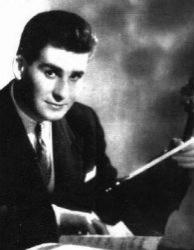
Ferdinand Laub
 Czech
Czech- Biography of Ferdinand Laub
- Early Life and Education
- Career and Musical Influence
- Musical Mastery and Recognition
Biography of Ferdinand Laub
Ferdinand Laub was a Czech violinist, teacher, and composer. He was a student of A. Mildner and led the quartet of the Russian Musical Society. From 1848 to 1864, he worked in Vienna, Weimar, and Berlin. He was a professor at the Moscow Conservatory from 1866 to 1874. Laub was known for his numerous violin pieces and was referred to as the "violin titan" by P. I. Tchaikovsky. V. F. Odoyevsky considered him a true artist and contrasted him with many salon virtuosos and their superficial "effectful" playing. One critic wrote, "Everything he touched came alive in his hands as a work of great art, the source of which was the human soul."
Early Life and Education
Ferdinand Laub was born on January 19, 1832, in Prague. His father, Erasmus, a professional musician, became his first teacher. At the age of six, Ferdinand had his first performance at a private concert, playing variations by Beriot. Due to his small stature, he had to be placed on a table to reach the violin. Two years later, he gave his first public concert, marking the beginning of his concert tours around Bohemia and Moravia. The renowned Norwegian violinist Ole Bull, who was once introduced to the young Ferdinand, was impressed by his talent and predicted a brilliant future for him. Soon, Laub began giving concerts in various Austrian cities. During a performance in Prague, he caught the attention of the famous violinist and pedagogue M. Mildner, who offered to teach the talented child for free. In 1843, Laub entered Mildner's class at the Prague Conservatory, finishing it brilliantly at the age of 14.
Career and Musical Influence
During his time at the conservatory, Laub captivated the playing of the renowned Moravian violinist Ernst and the outstanding French composer Berlioz, who urged him to go to Paris. It is not surprising that after graduating from the conservatory, Laub had no shortage of concert opportunities. However, after the Prague uprising in 1848, which was suppressed by Austrian authorities, terror gripped the country. Like many other patriots, Ferdinand found himself in forced exile. He lived in Vienna for two years, where he played in the opera orchestra as a soloist and concertmaster. Additionally, Laub studied music theory and counterpoint with the Czech composer Simon Sechter. In 1859, Laub moved to Weimar, where he took the place of Joseph Joachim, who had moved to Hanover. Here, Laub had frequent interactions with Liszt, who highly valued him as a performer. "There is no doubt that Laub's interactions with Liszt, with whom he often played while in Weimar, and who highly valued Laub's mastery, must have had a significant influence on the development of his artistic thinking and feeling, which keenly perceived everything significant in music," wrote one of Laub's biographers, Professor Josef Zubaty.
In Weimar, Laub became friends with Smetana, sharing his patriotic aspirations and hopes. From Weimar, Laub frequently traveled with concerts to Prague and other cities in Bohemia. It was in Weimar in 1854 that Laub married Anna Maresh, whom he met in Nová Huta during one of his visits to his homeland. Anna, an extraordinary singer, often toured with her husband. She gave birth to five children, two sons and three daughters, and became his most devoted friend. From 1885 until the end of her life in 1899, Anna taught singing at the Music School of the Moscow Philharmonic Society.
In 1856, Laub moved to Berlin, where he held the position of "chamber virtuoso." He occasionally performed solo concerts, organized trios and quartets, and also taught violin. He often went on concert tours. Laub did not forget his homeland and spent summers in Bohemia, where he performed many concerts and participated in charity concerts organized by Czech national cultural organizations.
Musical Mastery and Recognition
Laub's mastery of the violin was already admired by the world's greatest musicians. However, in the early 1850s, his playing was primarily noted for its virtuosity. In a letter to his brother in London in 1852, Joseph Joachim wrote, "It is amazing what brilliant technique this man possesses; for him, there are no difficulties." Laub's repertoire at that time was filled with virtuosic music, such as concertos and fantasies by Bazzini, Ernst, and Vieuxtemps. Later, he focused on classical works. From 1859, he embarked on six years of relentless and triumphant concert activity. Laub gave concerts in Germany, Belgium, the Netherlands, England, and other countries. His highly successful tour with the famous singer Adelina Patti was particularly notable.
Until 1865, Laub lived in Vienna. When he left Vienna, the Vienna Philharmonic Society presented him with a golden wreath inscribed "To King of Violinists Ferdinand Laub." In the early 1860s, the musician spent a lot of time in Bohemia, actively participating in its musical life. He often performed at concerts dedicated to Czech music. In 1861, during the celebration of the 50th anniversary of the Prague Conservatory, Laub performed Beethoven's concerto.
Alongside Smetana, Laub was one of the most active members of the famous Czech association of art representatives, "Umělecká beseda." The motto of this society was "With song to the heart, with the heart to the homeland." At the opening of the society's music section on August 14, 1863, Laub and Smetana performed Beethoven's Kreutzer Sonata.
In 1859, Laub visited Russia for the first time. His performances in St. Petersburg, featuring works by Bach, Beethoven, and Mendelssohn, caused a sensation. A.Serov called Laub a "true demi-god" and dedicated a series of articles to him, paying special attention to his interpretation of the music of Bach, Mendelssohn, and Beethoven. "Laub's performance of Bach's Chaconne, again astonishing with his bow and left hand, his dense tone, wide range of sound under his bow, which strengthened the violin fourfold compared to the usual, his most delicate nuances in pianissimo, his incomparable phrasing, deeply delving into Bach's profound style!... Listening to this delightful music in Laub's exquisite performance, one starts to wonder if there can be any other music in the world, with a completely different style (not polyphonic), if any other style has the right to citizenship in art - as complete as the infinitely organic, polyphonic style of the great Sebastian," wrote Serov.
Laub also impressed Serov with his performance of Beethoven's Concerto. After the concert on March 23, 1859, Serov wrote, "This marvelously transparent, bright, angelically sincere music he played with his bow even better than in his concert at the Noble Assembly Hall. Amazing virtuosity! But in Laub, it exists not for its own sake but for the benefit of high musical works. If all virtuosos understood their significance and purpose like him!" "In quartets," writes Serov, after attending a chamber evening, "Laub seems even higher than in solo performances. He completely merges with the music he performs, something many virtuosos, including Vieuxtemps, cannot do."
The impressions of his first visit to Russia were so strong that during his extensive concert travels, Laub increasingly considered settling in Russia.
In 1865, Laub visited Russia for the third time. On March 6, he performed at an evening hosted by N. Rubinstein. V. A. Sollogub, a talented Russian writer, recounted this evening in a letter to the renowned Russian cellist and patron Matvey Vielgorsky. "Laub's playing amazed me to the point that I forgot about snow, blizzards, and illness... Laub's distinguishing characteristics to me were composure, sonority, simplicity, stylistic rigor, absence of affectations, clarity, and at the same time, intimate inspiration combined with extraordinary power... He is not dry like a classicist, not impulsive like a romantic. He is original, independent; he has, as Bryullov used to say, 'a touch of peculiarities.' He cannot be compared to anyone else. A true artist is always typical. He spoke to me a lot and asked about you. He genuinely loves you, as do all who know you. In his interactions, it seemed to me that he was straightforward, sincere, willing to recognize others' merits without being offended by them in order to elevate his own value..."
V. F. Odoyevsky published an enthusiastic article titled "Laub in Mozart's Re-Minor Quintet" in the "Moskovskiye Vedomosti" newspaper. "Those who have not heard Laub in Mozart's Re-Minor Quintet have not heard this quintet," he wrote. "Those who know the marvelous poem called the Re-Minor Quintet by heart, how rarely they have the opportunity to hear such an interpretation that fully satisfies our artistic sensibilities."
In his third visit to Russia in 1866, Laub signed a contract to work at the Moscow branch of the Russian Musical Society on March 1. At the invitation of N. Rubinstein, Laub became the first professor of the newly opened Moscow Conservatory in the autumn of 1866 and conducted fruitful pedagogical activities for eight years. He not only led the violin class but also the quartet and orchestra classes. Around thirty students passed through Laub's violin class during this time. Among them were V. Vuillaume, I. Loyko, and I. Kotek. The famous Polish violinist S. Barcewicz also began his education with Laub.
Laub's performing activities, especially in chamber music, were exceptionally highly regarded by his contemporaries. Tchaikovsky wrote, "In Moscow, there is a quartet performer who is looked upon with envy by all the capitals of Western Europe... " According to Tchaikovsky, in the world, only Joachim can rival Laub in the performance of classical works, "surpassing Laub in the ability to extract from his instrument tender and delicate melodies but undoubtedly inferior to him in tone strength, passion, and noble energy."
"Hearing him, I thought about how on this very stage, exactly a year ago, another violinist, full of life and strength, in the prime of his genius, played before the audience; that this violinist would never appear before any human audience again, that his hand, which produced sounds so powerful, potent, and yet gentle and caressing, would not thrill anyone anymore. G. Laub died at the age of only 43," wrote Tchaikovsky in a review of the concert by the virtuoso violinist C. Sivori.