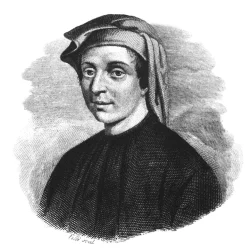
Fibonacci
 Republic of Pisa
Centuries before his name became shorthand for a famous number pattern, Fibonacci was a working mathematician whose books helped merchants and scholars calculate in a more flexible way. Born Leonardo of Pisa around 1170, he encountered mathematical learning across the Mediterranean and carried that knowledge into Latin Europe. His *Liber abaci* made Indo-Arabic arithmetic practical and accessible to readers who still relied heavily on Roman numerals.
A Pisan childhood shaped by travel
Leonardo was born in the maritime Republic of Pisa, a trading power whose merchants traveled widely. His father, Guilielmo, represented Pisan traders at the North African port of Bugia, now Béjaïa in Algeria. As a boy, Leonardo joined him there and studied calculation. He learned the Indian numerals and the place-value methods transmitted through Arabic-speaking mathematical traditions, and later traveled through the Mediterranean, including Egypt, Syria, Greece, Sicily, and Provence.
These journeys gave him a practical education rooted in commerce and exposed him to mathematical approaches that were not yet common in western Europe. Around 1200 he returned to Pisa and began writing the books through which his work would reach other scholars. Very little is known about his private life; the main evidence comes from his own writings and a handful of civic records.
Making arithmetic useful
In 1202, Leonardo completed *Liber abaci*, or “Book of Calculation,” revising it in 1228. The expansive work explained how to calculate with the nine numerals and zero using a decimal place-value system. It showed how the approach could solve everyday problems involving currency conversion, prices, profit, partnership, and measurement. The system did not originate with Leonardo: it had a much longer history in India and the Islamic world. His achievement was to explain its power in a form that helped it gain a wider audience among European merchants and scholars.
The book also included mathematical puzzles, among them a problem about how rabbit pairs multiply under a set of idealized rules. Its solution produces the pattern now called the Fibonacci sequence: each number is the sum of the two before it, as in 1, 1, 2, 3, 5, 8, and so on. Leonardo did not invent the pattern, and the nickname “Fibonacci” became attached to him much later. The sequence is a small part of a much larger book, but it became the most recognizable afterlife of his work.
Leonardo wrote beyond arithmetic. *Practica geometriae* (1220) brought geometry to practical questions such as surveying and measurement. In *Liber quadratorum* (“Book of Squares”), he explored number theory, including square numbers and problems connected to Pythagorean triples. Around 1225, he also answered mathematical challenges posed by scholars in the circle of Holy Roman Emperor Frederick II; his solutions appeared in *Flos* (“Flower”).
Recognition and legacy
Leonardo’s ability was recognized in his own lifetime. In 1240 the Pisan authorities granted him an annual salary for advising the city on accounting and calculation and for teaching citizens. A document calls him “Master Leonardo Bigollo”; the epithet likely referred to a traveler. Records after this point are scarce, and his exact death date is unknown, though it is generally placed after 1240 and around the middle of the century.
His lasting importance lies in more than the sequence that bears his later nickname. By drawing on mathematical knowledge developed across cultures and setting it out in practical Latin texts, Leonardo helped reshape how calculation was taught and used in Europe. His books connected the needs of trade with deeper work in algebra, geometry, and number theory, making him one of the most influential mathematical writers of the medieval period.