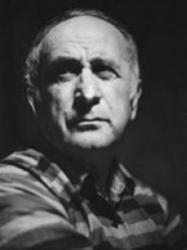
Fletcher Benton
 USA
USA- Fletcher Benton: Pioneer of Kinetic Art
- Geometric Forms in Metal
- Kinetic Art: The 1960s and Beyond
- Fletcher Benton: The Later Years
Fletcher Benton: Pioneer of Kinetic Art
Born in Jackson, Ohio in 1931, Fletcher Benton is an American sculptor and one of the pioneers of kinetic art. He received his BFA at Miami University in Oxford, Ohio, and began teaching at California College of Arts & Crafts in Oakland in 1959. He also taught at the San Francisco Art Institute (1966-67) and San Jose State University (1967-86). Throughout his career, his sculptures have been exhibited in both solo and group shows. Benton's work is held in the permanent collections of the Denver Art Museum, Hirshhorn Museum (Washington, D.C.), Milwaukee Art Museum, New Orleans Museum of Art, Oakland Museum of California, Whitney Museum of American Art (New York City), San Francisco Museum of Modern Art, the DeCordova Museum (Lincoln, Massachusetts), and elsewhere. He currently lives and works in California.
Geometric Forms in Metal
Fletcher Benton is renowned for his geometric metal sculptures. His sculptures often defy gravity, with welded forms precariously balanced upon one another. His choice of material reflects his fascination with the unique color, tone, and luster of metal.
Kinetic Art: The 1960s and Beyond
During the 1960s, Fletcher Benton embarked on a period of experimentation with kinetic sculpture. It was the "golden age" of kinetic art, and Benton's colorful, mechanized sculptures made of metal and plastic brought him widespread recognition. In the late 1970s, Benton moved away from kinetic art, transitioning to more traditional sculpture using bronze and steel. Today, Benton creates monumental sculptures on private and public commissions for collectors and museums alike.
Fletcher Benton: The Later Years
Over the years, the materials and scale of Benton's work have undergone dramatic changes, but he remains committed to geometric abstraction, drawing inspiration from the circle, the square, letters, and numbers. Each of the geometric elements that comprise Benton's monumental steel sculptures is carefully calibrated, considering the thickness and weight of the metal in intricate configurations. The circle has emerged as a primary element in many of Benton's recent sculptures. Serving as a frame or anchor for the other geometric elements, the circle emphasizes dynamics of balance and imbalance.