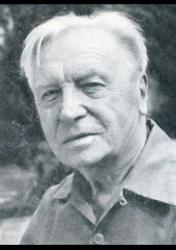
Anthony Caro
 Great Britain
- Early Life and Education
- Influence of Henry Moore
- Breakthrough in Abstraction
- Industrial Materials and Abstract Forms
- Sculptural Variety
Early Life and Education
Anthony Carowas born in London on March 8, 1924. He studied engineering at Christ's College, Cambridge, before turning his attention to sculpture after the war. He attended the Regent Street Polytechnic School (1946) and the Royal Academy Schools (1947-1952).
Influence of Henry Moore
During the 1950s, Caro's early figurative sculptures were heavily influenced by the monumental forms of his mentor, Henry Moore, particularly his assistant role from 1951 to 1953.
Breakthrough in Abstraction
In 1959, a brief trip to the United States exposed Caro to the work of abstract expressionist sculptors like David Smith, Kenneth Noland, and Joseph Stella. Inspired by their approach, Caro abandoned representation and began using industrial materials, such as steel girders, in his sculpture, notably in "Noon" (1960).
Industrial Materials and Abstract Forms
Caro's unique approach involved incorporating aluminum tubes, steel grills, boiler caps, snowplows, drawer handles, and other found objects into his sculptures. His aim was to explore the possibilities of abstract thought in sculpture through the language of modern industrial technology.
Sculptural Variety
Caro created a wide range of works, from the simple zig-zag configuration of "Shaftesbury" (1965) to the complex and curvilinear "Greenhouse" (1969). Some of his sculptures evoke organic or landscape forms, reminiscent of Henry Moore's work.