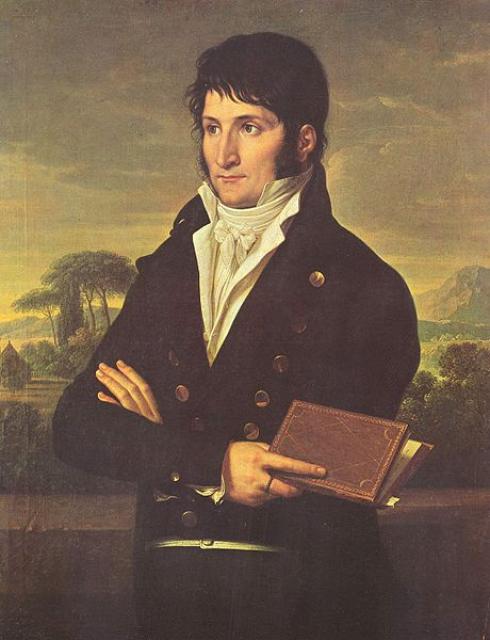
Francois-Xavier Fabre
 France
- Biography of François-Xavier Fabre
- Early Success and Scholarship
- Challenges in Rome and Relocation to Naples and Florence
- Legacy and Contributions
Biography of François-Xavier Fabre
François-Xavier Fabre was a French historical painter, known for his strict drawing style and his devotion to the pseudo-classical style of his mentor, Jacques-Louis David. He was born in Montpellier and began his artistic education under the guidance of Guillaume Coustou. Later, he became a student of Jacques-Louis David, a prominent neoclassical painter.
Early Success and Scholarship
In 1787, Fabre received a prestigious scholarship from the Paris Academy of Fine Arts for his painting "The Murder of the Children of Zedekiah." This recognition allowed him to travel to Rome as an academy stipend, where he further honed his skills and immersed himself in the rich artistic culture of the city.
Challenges in Rome and Relocation to Naples and Florence
However, due to the political tensions between the French Convention and the papal government, Fabre faced difficulties in Rome. In 1793, he decided to relocate to Naples, where he stayed for about a year. After leaving Naples, he settled in Florence, Italy, where he focused on creating historical paintings and landscapes.
During his time in Florence, Fabre formed a close friendship with the poet Vittorio Alfieri. He also developed a deep bond with the Countess of Albany, the widow of Charles Edward Stuart. In her will, the Countess bequeathed her entire estate to Fabre, including valuable manuscripts by Alfieri. In 1826, Fabre returned to his hometown of Montpellier, bringing with him his extensive art collection and library, which he had amassed during his time in Italy.
Legacy and Contributions
Fabre's generous donation of his art collection and library to the city of Montpellier led to the establishment of a dedicated museum. The museum became a testament to his artistic achievements and a center for cultural education. Additionally, Fabre founded an art school in Montpellier, which he continued to support until the end of his life.
In recognition of his contributions to the arts and education, Fabre was appointed to the baronage in 1830. Today, most of his works, including historical paintings and portraits, can be found in the Fabre Museum in Montpellier. However, his paintings can also be found in museums in Lyon, Nantes, and Narbonne. One notable work, "Neoptolemus and Ulysses Stealing the Arrows of Philoctetes," is housed in the Louvre Museum in Paris.
François-Xavier Fabre's artistic legacy as a disciplined draftsman and a follower of the pseudo-classical style of Jacques-Louis David continues to inspire and captivate art enthusiasts around the world.





