Frank Rosenblatt
 USA
USABiography of Frank Rosenblatt
Frank Rosenblatt, an American scientist and expert in psychology and computer technology, made a significant contribution to the field of information technology with his invention of neural networks. Born in New Rochelle, New York, Frank Rosenblatt was the son of Dr. Frank Rosenblatt and his wife Catherine. He completed his education in 1946 and obtained his bachelor's degree in 1950. In 1956, he earned his doctorate degree.
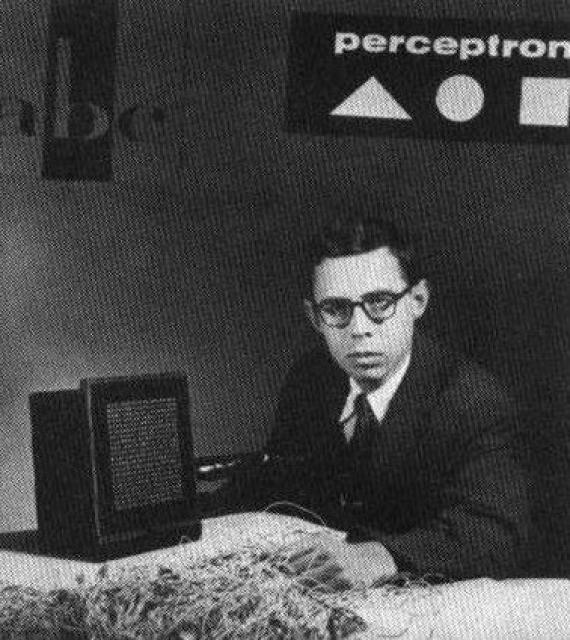
After completing his studies, Frank joined the Cornell Aeronautical Laboratory in Buffalo, New York, where he conducted research in the field of psychology and led a group on cognitive systems. It was here that Rosenblatt began working on perceptrons, and his developments eventually led to the creation of the hardware version of the "Mark I Perceptron," the first computer capable of learning through trial and error using neural networks. It was this invention that brought Rosenblatt fame.
Initially, Frank's perceptrons were only simulated on computers in his laboratory, but the program was able to memorize and learn to recognize patterns quite effectively. Rosenblatt continued to improve and refine his invention, publishing his theories and methods in books and articles. When the perceptron was finally unveiled to the world as a functioning device, it created a tremendous impact among specialists and journalists. Perceptrons were seen as the future of information technology. However, the enthusiasm subsided to some extent when Marvin Minsky and Seymour Papert published a book that mathematically proved the limitations of Rosenblatt's three-layer perceptron.
Frank Rosenblatt had a wide range of interests. In 1959, he moved to one of Cornell's campuses as the director of the Cognitive Systems Research Program. He also worked as a lecturer in the psychology department. In 1966, Frank joined the neurobiology and behavior research group at the newly created College of Biological Sciences. He continued his active research on the transfer of learned behavior mechanisms from one rat to another using brain extracts. Over the years, Rosenblatt published numerous works on this topic and ultimately concluded that if memory and skills transfer occurred, it was only to a very limited degree.
In 1970, Frank became a field representative for the neurobiology and behavior research team, and in 1971, he became the acting chair of the section. Astronomy was another area of interest for Frank Rosenblatt. He developed a new technology that allowed the detection of satellites around stars. Rosenblatt worked in his own observatory, built on a hill behind his home in Brooktondale, located six miles east of Ithaca. After the completion of the observatory, he became an active participant in the SETI project.
Unfortunately, on July 11, 1971, his 43rd birthday, Frank Rosenblatt tragically died in a boating accident in Chesapeake Bay. The world lost a great scientist, but his contributions to the fields of psychology, computer technology, and neural networks continue to influence and inspire researchers to this day.