
Franklin Roosevelt
 USA
USA- Biography of Franklin Roosevelt
- Founder of the Modern American Presidency
- Foreign Policy Leader
- Early Life and Personal Challenges
- Political Career
Biography of Franklin Roosevelt
Franklin Delano Roosevelt, the 32nd President of the United States, was born on January 30, 1882. He is considered the most prominent and influential politician of the 20th century in the U.S. Roosevelt served as president during the Great Depression and World War II, which gave him the opportunity for historical greatness. While he faced both admiration and criticism from his contemporaries, his significance has only grown with time for three reasons.

Founder of the Modern American Presidency
Historians and political scientists widely agree that Roosevelt is the founder of the modern American presidency. During his time in office, he introduced interventionist government policies and a mixed economy, in which the federal government in Washington took an active role in regulating, correcting, planning, and managing the economy. These policies became a part of everyday life for Americans.

Foreign Policy Leader
Roosevelt also demonstrated unwavering determination in foreign policy, recognizing the threat posed by German National Socialism, Japanese imperialism, and Italian fascism before most Americans. When the future of Western civilization was at stake in 1940 and 1941, he became the last hope for the Democrats and a direct alternative to Hitler. Through his strength of character and tactical finesse, Roosevelt prevented the isolation of the United States in the Western Hemisphere and emerged as a great victor in World War II. His death marked the rise of the U.S. as a new superpower.

Early Life and Personal Challenges
Franklin Roosevelt was born into a wealthy family on the sunny side of society. He was the only child of his father James Roosevelt, a farmer, merchant, and man of leisure, and his mother Sara, who was 26 years younger than her husband and brought a dowry of one million dollars. Despite their wealth not comparing to the Vanderbilts and Rockefellers, the Roosevelt family held an esteemed social position among the leading families of New England.
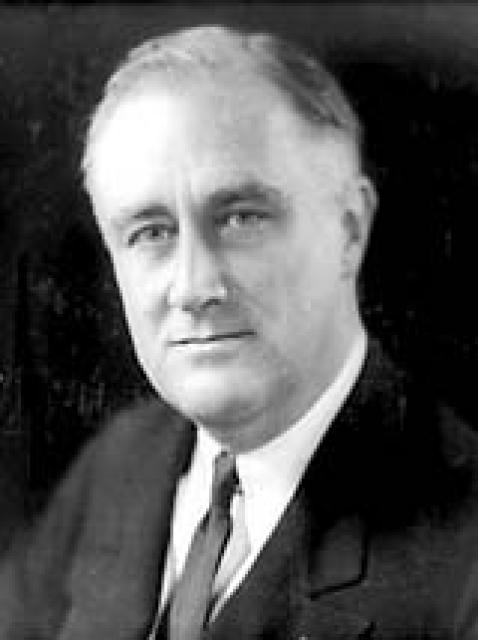
Franklin received a privileged upbringing, rich in events and ideas, which instilled in him a sense of confidence and a belief in the world. However, his life took a turn when he contracted polio in 1921. Despite his efforts over many years to overcome the disease, Roosevelt was left paralyzed and confined to a wheelchair. He wore steel braces weighing ten pounds to stand and could only move slowly with the help of crutches. Despite his inner struggles, he presented an impeccable facade, exuding hope and confidence, refusing to entertain thoughts of disappointment or self-pity.
Roosevelt married Eleanor Roosevelt, his distant cousin and niece of President Theodore Roosevelt, in 1905. The marriage transformed Eleanor from a shy and modest homemaker and mother to a woman who would be admired more than any other in the United States in the 1930s and 1940s. Alongside her various social and political activities, Eleanor fought tirelessly for women's rights, labor movements, and the underprivileged in American society. Their marriage became a political partnership, with Eleanor embodying Franklin's "left conscience."
Political Career
Roosevelt's political career followed the path set by Theodore Roosevelt: serving as Secretary of the Navy, Governor of New York, and ultimately President. He was elected President of the United States on November 8, 1932, after a fierce campaign against incumbent President Herbert Hoover. Roosevelt promised a "New Deal" for the country, advocating for radical government intervention to combat the economic crisis and alleviate the suffering of millions of Americans.
As President, Roosevelt pushed the limits of executive power, surpassing any previous president. He took control of legislative initiative from Congress and expanded the legislative function of the presidency. Roosevelt vetoed a record 635 bills during his time in office and used personal persuasion, patronage, and public pressure to influence Congress. He also skillfully used the media, particularly newspapers and radio, to communicate his policies and ideals to the American public.
Roosevelt's policies and actions significantly shifted the balance of power towards the executive branch, making the White House the center of American government and the source of new ideas. His presidency marked a turning point in American politics and solidified the role of the president as the embodiment of the public's expectations and hopes.
Despite his untimely death in 1945, Franklin Roosevelt's legacy as a transformative leader and the architect of the modern presidency remains intact. His actions during the Great Depression and World War II continue to shape American politics and society to this day.


