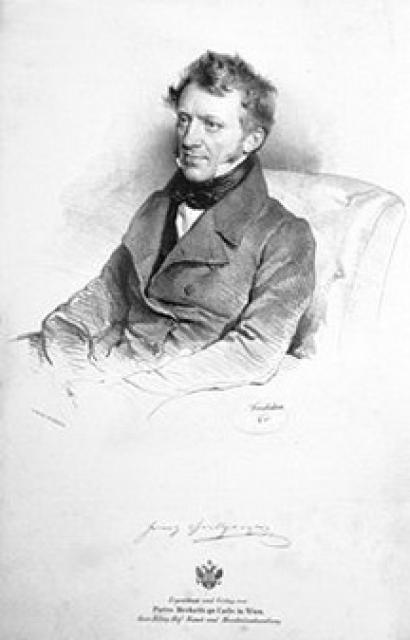
Franz Grillparzer
 Austria
- Franz Grillparzer, an Austrian Literary Luminary
- Literary Career
- Historical and Philosophical Influences
- Literary Contributions
- Controversial and Acclaimed Dramas
- Posthumous Recognition
- Legacy
Franz Grillparzer, an Austrian Literary Luminary
Early Life and EducationFranz Grillparzer was born on January 15, 1791, in Vienna, Austria, to lawyer Wenzel Grillparzer and Marianne (née Sonnleithner). In 1807, he began studying law in Vienna, which he pursued until 1811. Despite his legal studies, Grillparzer's passion for literature emerged early on.
Literary Career
At the age of sixteen, Grillparzer embarked on his literary journey. He wrote a range of works, including short stories, travelogues, critical essays, and poetry. However, he is best known for his dramas, which have been translated into numerous languages. Notable among them are the tragedies "The Ancestress" ("Die Ahnfrau") and "Sappho" ("Sappho").
Historical and Philosophical Influences
Grillparzer's fascination with history, philosophy, and literature deeply influenced his works. He meticulously researched various cultures and time periods, which is evident in his dramas and critical essays. He often explored themes related to the Austrian monarchy, its history, and the social issues of his time.
Literary Contributions
Beyond his dramas, Grillparzer penned numerous lyric poems, including the cycle "Tristia ex Ponto" ("Elegies from the Black Sea"). He also authored two acclaimed novellas, "The Monastery at Sendomir" ("Das Kloster bei Sendomir") and "The Poor Musician" ("Der arme Spielmann").
Controversial and Acclaimed Dramas
Many of Grillparzer's dramas confronted the oppressive regime of Chancellor Metternich, leading to censorship and unfavorable reactions from certain segments of society. His comedy "Woe to the Liar" ("Weh' dem, der lügt") sparked such a backlash that Grillparzer chose to withdraw his plays from public performance.
Posthumous Recognition
Despite the controversies surrounding his work, Grillparzer is hailed as one of the most significant Austrian dramatists. His dramas seamlessly blend elements of classicism, romanticism, and realism. Posthumously, three of his tragedies, "Libussa," "A Family Feud in Habsburg," and "The Jewess of Toledo," were published in 1873.
Legacy
Franz Grillparzer died on January 21, 1872, at the age of 81. He is remembered as a prolific writer and a cornerstone of Austrian literature. In 1889, a monument was erected in his honor in Vienna's Volksgarten park. Grillparzer's works continue to inspire and captivate readers to this day.


