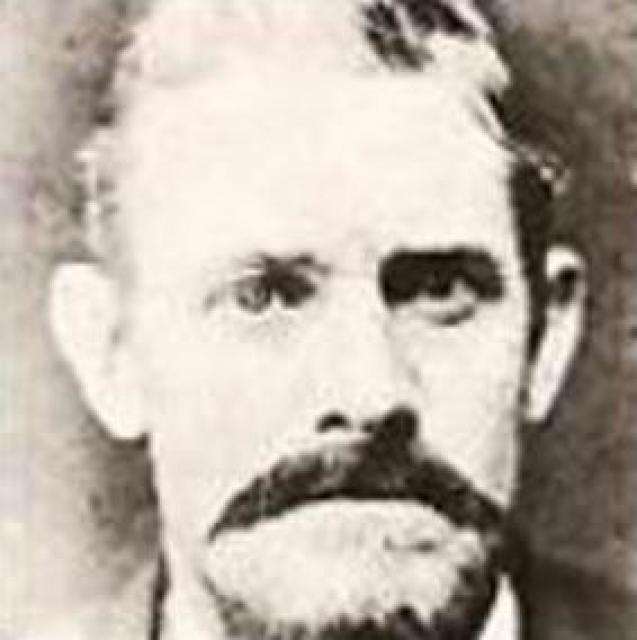
Frederick Bailey Deeming
 Australia
Biography of Frederick Bailey Deeming
Frederick Bailey Deeming was an Australian killer of English descent. He was born on July 30, 1853, in Leicestershire, England, to Thomas Deeming, a coppersmith, and his wife Ann Bailey. According to writers Christopher Wray and Maurice Gurvich, he was described as a "difficult child". At the age of 16, Frederick ran away to sea, beginning his lengthy criminal career, primarily involving theft and fraud. He was also responsible for the murder of his first wife, Marie, and her four children, as well as his second wife, Emily, in 1891.
After the discovery of Emily's body in Windsor, Melbourne, in March 1892, Deeming was swiftly executed for her murder in May. This was an unusually short timeframe compared to modern Western legal standards, attributed to the remarkably efficient work of the police and the international media's interest in the case.
Police investigations following his arrest revealed that Deeming had moved to Australia in 1882, primarily working in Sydney and for John Danks, an importer of plumbing and pipeline supplies from Melbourne. His employers considered Deeming an excellent worker and even extended him credit to start his own business. However, he was accused of stealing brass fittings in Sydney, some of which were found in his home, and was sentenced to six weeks of imprisonment. Deeming fainted when the sentence was read out. After his release, he continued working as a gas fitter in Sydney until he was again brought to court in 1887 for fraudulent bankruptcy charges. After being released on bail, Deeming immediately disappeared from New South Wales.
In Australia, Frederick lived with his wife Marie, described as a "typical Welsh girl," whom he married in February 1881. His brother Alfred married Marie's sister, Martha. By 1886, Frederick and Marie had two daughters, Bertha and Marie. In 1888, his brothers Alfred and Walter learned that Deeming and his family had returned to England "with a significant fortune." Police and newspaper investigations later discovered that Deeming had lived in Cape Town, South Africa, from 1888 to 1889, during which time Marie gave birth to another child. It is known that Frederick acquired wealth through a scam involving a diamond mine in Transvaal. He returned to England on the ship "Yumna," where the captain and passengers remembered him flaunting his valuables and money.
In November 1889, Deeming arrived in Hull, where he posed as a "former sheep farm worker named Harry Lawson from Rockhampton, Queensland, earning £1,500 a year." He courted Helen Matheson, the 21-year-old daughter of his landlady, whom he married on February 18, 1890. Approximately a month after their honeymoon, he suddenly disappeared, taking expensive wedding gifts with him. Helen and her family learned about his bigamy. The events eventually led to Birkenhead, where Frederick visited Marie and their four children, claiming that he had been absent in South Africa during that time. In reality, in Hull, Frederick was involved in jewelry fraud, was arrested upon arrival in Montevideo, extradited back to England on charges of "obtaining goods by false pretenses," and sentenced to nine months in prison.
Upon his release in July 1891, Deeming, using the alias Albert Williams, settled in a hotel in Rainhill, where a mysterious woman (likely his wife Marie) claiming to be his sister visited him. Deeming allegedly rented a house in Rainhill on behalf of his military friend, a certain Colonel Brookes, and was seen there with his "sister and her children." During this period, he mentioned that it was time to change the kitchen floor and closely monitored all the work done at the house. He also began courting Emily, the daughter of a widowed local shopkeeper, and they were married on September 22, 1891. In November 1891, Frederick and Emily arrived in Australia on the German steamship "Kaiser Wilhelm II" and rented a house in the Melbourne suburbs. On December 24 or 25, he killed Emily and buried her body under the house, covering it with cement. He paid a month's rent in advance, using the alias Mr. Drew, and left the house almost immediately. On March 3, 1892, a potential tenant complained about a "foul smell" in one of the bedrooms. When the smell became unbearable, the police were called, and Emily's body was discovered. Although her skull showed signs of multiple blows, the most likely cause of death was a severed throat.
The investigation into her death led directly to the passengers of the German steamship, who claimed that Mr. Williams treated his wife with love and care. Based on a detailed physical description of the man whose true identity was never established, the police discovered a suitable person of interest. On March 12, 1892, Deeming was arrested. At the time of his arrest, several personal belongings of Emily, including her prayer book, were found in his possession.
In Rainhill, decomposing bodies of Marie and her four children – Bertha (9 years old), Marie (7), Sydney (5), and Lila (18 months) – were discovered buried beneath the renewed floor of the house Deeming had rented. Bertha had been strangled, while the others had their throats slit. It appeared that Frederick had disposed of them all when he began his affair with Emily.
During his trial, Deeming's lawyer argued his client's insanity, and Deeming himself, apparently seeking to strengthen this defense, revealed how he contracted syphilis in London and claimed that the ghost of his mother compelled him to kill. He stated that Emily had run away with another man, rather than died, and that the thought of it comforted him. However, the jury "sent him straight to hell," and on May 23, 1892, at 10:01 am, Frederick was hanged.
To this day, speculations persist that Frederick Bailey Deeming was, in fact, the infamous figure known as Jack the Ripper.


