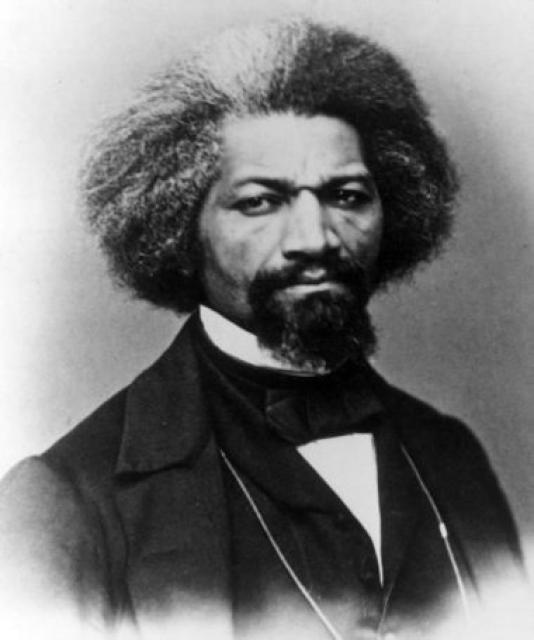
Frederick Douglass
 USA
USABiography of Frederick Douglass
Frederick Douglass was an African American social reformer, abolitionist, orator, writer, and statesman. He was born as Frederick Augustus Washington Bailey in 1818 in Talbot County, Maryland. At a young age, he was separated from his mother and raised by his grandmother, Betty Bailey. When he was around seven years old, he was sent to live with his white slave owner, Aaron Anthony, whom he considered his father for some time.

After Anthony's death, Douglass was sent to live with Thomas Auld's wife, Sophia Auld, who defied the laws of Maryland by teaching him the alphabet. Douglass secretly continued his education and realized that "education and slavery were incompatible," becoming more determined to fight for freedom. He read newspapers, pamphlets, political materials, and books of various genres, which led him to believe that no person should be enslaved.

Douglass was later hired by William Freeland, who allowed him to teach other slaves to read on the plantation. However, this educational activity was seen as a threat by most plantation owners, and a mob armed with clubs and stones raided the school, forcing its closure. In 1833, Douglass was sent back to the Aulds and then to Edward Covey, a cruel farmer who frequently beat him. Despite the abuse, Douglass found the courage to fight back, after which Covey never laid a hand on him again.

His first attempt to escape slavery was made while working for Freeland, but it was unsuccessful. In 1837, Douglass met and fell in love with Anna Murray, a free African American woman from Baltimore. Their meeting further strengthened Douglass's belief that he had the right to break free from slavery. Murray helped Douglass obtain a sailor's uniform for his escape and provided him with the necessary documents to prove his status as a free black sailor. On September 3, 1838, Douglass boarded a train in Wilmington, Delaware, and then a steamboat to Philadelphia, Pennsylvania. He eventually made his way to the home of abolitionist David Ruggles in New York. The entire rescue operation took less than a day.
After escaping slavery, Douglass became a prominent leader in the abolitionist movement. He was known for his exceptional oratory skills and ability to convey his thoughts through writing. His autobiography, "Narrative of the Life of Frederick Douglass, an American Slave," published in 1845, became a bestseller and influential work in support of the abolitionist cause. He continued to advocate for the freedom of slaves and wrote his last autobiography, "Life and Times of Frederick Douglass," after the Civil War.
Douglass also supported women's suffrage and believed in the equality of all people, regardless of race, gender, or nationality. He once stated, "I would unite with anybody to do right and with nobody to do wrong." Frederick Douglass remains a powerful symbol of the fight against slavery and inequality, using his eloquence and intelligence to challenge the notion that slaves lacked the intellect to be independent American citizens.