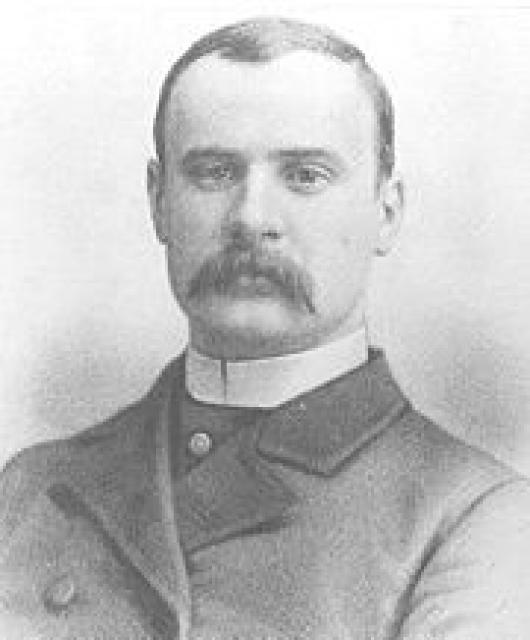
Frederick Treves
 Great Britain
Biography of Frederick Treves
Frederick Treves (February 15, 1853 – December 7, 1923) was an eminent British surgeon during the Victorian era. He was a Knight Grand Cross of the Royal Victorian Order, a Knight of the Order of the Bath, and a recipient of the Victoria Cross. In addition to his medical career, Treves was known for his friendship with Joseph Merrick, also known as "The Elephant Man," about whom Treves wrote memoirs.
Early Life and Education
Frederick Treves was born in Dorchester, Dorset, as the son of a laborer. He received his medical education at the London Hospital Medical School and in 1879, he became an assistant surgeon at the London Hospital (now the Royal London Hospital). Later, Treves became a lecturer at the medical school affiliated with the London Hospital. He started as a demonstrator of practical anatomy (1881-1884) and later became a lecturer in anatomy (1884-1893), a teacher of operative surgery (1893-1894), and a lecturer in surgery (1893-1897).
Medical Career
In 1882, Treves published his first scientific work, "Scrofula and its Gland Diseases." Alongside his scientific and teaching activities, Treves also had a successful private practice. He established his own surgical clinic, specializing in abdominal surgeries. The practice was so successful and lucrative that in 1898, Treves resigned from his position as a surgeon at the London Hospital.
During his career as a physician, Treves participated in the Second Boer War (1899-1902). Two of his most famous patients were King Edward VII of England and Joseph Merrick. In 1902, Treves performed an appendix removal surgery on the king, just two days before his scheduled coronation. Although the king was initially reluctant to postpone the coronation, Treves insisted on the necessity of the operation. As a result, the coronation was delayed by a month and a half. The surgery was successful, and the following year, the king bestowed the baronetcy title upon Treves.
Another famous patient of Treves was Joseph Merrick, known as "The Elephant Man," who gained widespread recognition due to his deformities caused by neurofibromatosis type I and Proteus syndrome. Treves wrote memoirs about Merrick, which later served as the basis for Bernard Pomerance's Broadway play and David Lynch's film. In Treves' book, Merrick is mistakenly referred to as John instead of Joseph, leading to widespread misconceptions about Merrick's name (including in the aforementioned film where he is also called John).
Personal Life and Legacy
In 1877, Treves married Anne Elizabeth Mason from his hometown of Dorchester. After retiring, King Edward VII granted Treves an estate in Richmond Park. However, health issues forced Treves to relocate to Lake Geneva in Evian, France in 1920. On December 7, 1923, Treves passed away. His remains were cremated, and his ashes were interred at the cemetery in Dorchester. Among those present at Treves' funeral was the English poet Thomas Hardy, a long-time friend of Treves.





