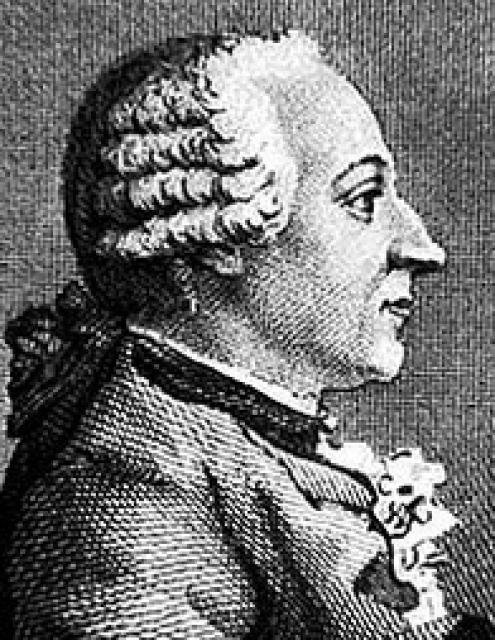
Friedrich Melchior Grimm
 Germany
- Friedrich Melchior Grimm: A Man of Letters and Diplomacy
- Parisian Fame and "Correspondance Littéraire"
- Diplomatic and Imperial Connections
- Controversial Character
- Correspondences and Legacy
Friedrich Melchior Grimm: A Man of Letters and Diplomacy
Early Life and Literary BeginningsFriedrich Melchior Grimm was a German Enlightenment publicist and diplomat who made a name for himself in Parisian society and as a close correspondent of Empress Catherine II of Russia. As a young student, he corresponded with Johann Christoph Gottsched, who encouraged him to write his weak tragedy "Vanissa" (1743). Later, he obtained a position as secretary to the Saxon envoy at the German Imperial Diet.
Parisian Fame and "Correspondance Littéraire"
In 1748, Grimm arrived in Paris and made the acquaintance of many influential figures of the time. His critical analysis of French music in his pamphlet "Lettre de M. Grimm sur Omphale, tragédie lyrique" (1752) garnered public attention. When the arrival of Italian opera in Paris split opinions among French music enthusiasts, Grimm authored the witty pamphlet "Le petit prophète de Boehmischbroda," which achieved great success.
Grimm became a highly sought-after correspondent for European monarchs. From 1747, he produced the "Nouvelles littéraires" for the Duchess of Saxe-Gotha. In 1753, he began his "Correspondance littéraire, philosophique et critique," which he shared with the same duchess. Grimm's "Correspondance" covered a wide range of literary, theatrical, and cultural events in Paris, providing valuable insights into the intellectual and artistic life of the period.
Diplomatic and Imperial Connections
In 1759, Grimm was appointed envoy to the court of Versailles by the city of Frankfurt. In 1776, he met Empress Catherine II of Russia and struck up a close friendship. He declined Catherine's offer to move to Russia but continued to correspond with her throughout her life. In 1792, she appointed him Russian resident in Gotha and later in Hamburg.
Controversial Character
Despite his success, Grimm attracted criticism for his obsequious personality and self-serving nature. He was unpopular with his friends, the Encyclopédistes, and Rousseau painted an unflattering portrait of him in his "Confessions."
Correspondences and Legacy
Grimm's correspondence with Catherine II is regarded as a valuable literary monument, revealing his wit and intelligence. In contrast, his letters to Catherine, filled with flattery and requests, present him in a less favorable light. Catherine's responses, however, offer insights into her character and reign.
As an official agent for Catherine II, Grimm received numerous rewards and financial support, which raised questions of impropriety. Catherine's generosity extended to the granddaughter of Grimm's mistress, Mme d'Épinay, whose dowry and marriage she arranged.
Grimm died in Gotha in 1807, nearly blind. His legacy lies in his literary contributions, particularly his "Correspondance Littéraire," which remains an important source for understanding the intellectual and social currents of the Enlightenment.




