Fukikid
 Greece
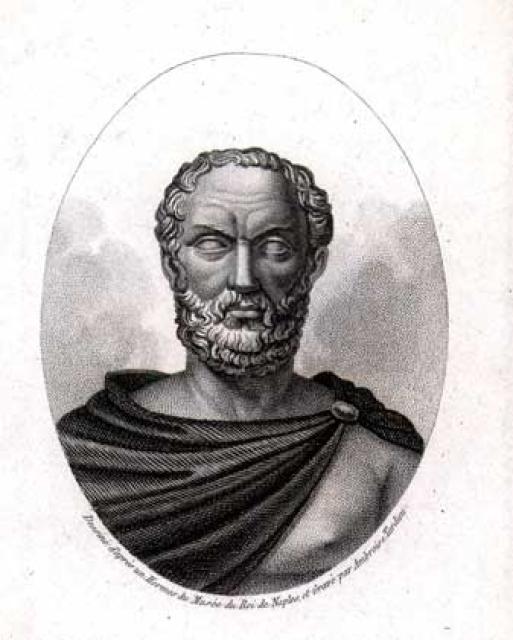
Biography of Thucydides
Thucydides, an ancient Greek historian, lived during the fifth century BCE. The exact dates of his birth and death are uncertain, but it is believed that he began writing his work, The History of the Peloponnesian War, at the start of the war in 431 BCE and intended to continue until 404 BCE. However, the narrative abruptly ends in 411 BCE.
Thucydides came from a prestigious family that owned gold mines in Thrace. His father, Olor, was possibly related to the famous general Miltiades and his son Cimon. Thucydides was also likely related to another Thucydides, the son of Melesias, who was opposed to Pericles. His noble lineage, wealth, and connections in Thrace proved advantageous when he was exiled in 424 BCE for failing to save Amphipolis from Spartan commander Brasidas.
In his youth, Thucydides associated with well-known statesmen, which provided him with the best preparation for writing his history. Despite his privileged background, Thucydides became a fervent supporter of Periclean democracy, extolling its ideals in Pericles' funeral oration. However, he also believed that the oligarchic constitution in 411 BCE was the best form of government Athens had ever known.
Thucydides mentions that he contracted a severe illness during the devastating plague that struck Athens from 430 to 427 BCE. During his exile, he visited the Peloponnese and possibly Sicily, as evidenced by his detailed description of Syracuse. His impartial nature benefited from his exile, allowing him to become acquainted with Athens' enemies. Some references to Sparta suggest that Thucydides may have met Alcibiades during this time.
After Athens surrendered in 404 BCE, Thucydides briefly returned to the city. It is reported that his death was violent, but this tradition may have arisen due to the abrupt ending of his narrative in Book VIII. Another unreliable source suggests that Xenophon, another historian, prepared Thucydides' work for publication. Xenophon's Greek History begins where Thucydides left off. Regardless of who edited Thucydides' History, he displayed remarkable restraint in his work.
The introduction to Book I emphasizes the importance of the chosen subject compared to previous events in world history. Thucydides discusses the causes of the war, which originated from the conflict between Athens and Corinth over Corcyra. However, the true causes lie deeper, as Sparta feared Athens' growing power. The war became a widespread conflict, dividing Greece in half. Generally, democracies sided with Athens, while oligarchic governments supported Sparta.
To demonstrate Athens' power, Thucydides provides an overview of the growth of the Athenian empire from 479 to 440 BCE, connecting his work to Herodotus' history of the Greco-Persian Wars. He details the life of Themistocles, who is reminiscent of Alcibiades, as both were highly regarded by Athens but eventually exiled to their enemies. Among the three brilliant politicians of this century, only Pericles managed to maintain power in a democratic state, although he incurred the citizens' disfavor toward the end of his life.
From the beginning of Book II to Chapter V 24, Thucydides describes the first stage of the war, known as the Ten Years (or Archidamian) War, up to the Peace of Nicias in 421 BCE. The narrative is accompanied by references to "winter" or "summer," dividing the year into two parts. After 424 BCE, when Thucydides was exiled, the description of events in Athens becomes less detailed, and the account of diplomatic negotiations with Persia is poorly presented.
Following the Peace of Nicias, there was a period without any apparent war, but former enemies continued to undermine each other's allies. The Spartans restored their prestige with a victory at Mantinea in 418 BCE, which Thucydides describes in detail. The "Melian Dialogue" (V 85–111) presents two parallel speeches, arguing point by point. The Athenians offer no concessions to the besieged Melians, openly stating that by the law of nature, the weak submit to the strong, and as long as Athens remains the ruler of the seas, Melos must obey and pay tribute. Books VI and VII describe the Athenian expedition to Sicily, initially doomed due to Alcibiades' defection and ultimately ruined by Nicias' incompetence. Book VIII is an incomplete account of the Decelean War, during which the Spartan army based in Attica kept Athens under constant pressure and deprived them of territory outside the city walls. This section also covers the oligarchic coup in Athens in 411 BCE and Persia's involvement during the war at sea in Ionia.
Thucydides writes concisely, avoiding embellishments. He often uses abstract concepts expressed through adjectives or participles with the neuter article. Thucydides tends towards oppositions but never deviates from the narrative for the sake of a symmetrical phrase. Sometimes, he deliberately changes the word order or sentence structure to surprise the reader. The result is occasionally sharp but never crude. Thucydides' prose is a finely tuned instrument of his sharp analytical mind. Much of the history was written in the heat of the moment, but the work progressed slowly and required great effort. Thucydides revised and added, incorporating additional information or subsequent events. Dating specific parts of the History is challenging, and conclusions are often unreliable. There is no doubt that there are sections inserted into the draft text, some even after Athens' surrender, such as II 65, 12.
The narrative is interspersed with speeches when the context justifies their inclusion. The prose of these speeches is complex and sometimes obscure. Thucydides could not accurately reproduce everything said by Athenian and Spartan commanders, nor did he attempt to do so. He presents the thoughts of the actors in his own manner, and in cases where he lacked records or memory, he composes speeches appropriate to the occasion. These speeches inject dramatic effects into the purely narrative work. Thucydides imposed strict rules for selecting material, at times causing him to omit events that a modern historian could not ignore without criticism. For example, he mentions that Hyperbolus was ostracized only when describing the death of this demagogue on Samos in 411 BCE and never mentions the clever maneuver by which Alcibiades orchestrated the exile of Hyperbolus, even though Hyperbolus initiated Alcibiades' banishment. Thucydides does not show much interest in social or economic problems, although he lists the resources available to Athens by the start of the war in Pericles' speech, thereby proving that at that time, they were entitled to expect a final victory. Pericles could not have foreseen the plague that left the Athenians hoping for a draw at best.
Thucydides does not always conceal his biases. He despised Cleon as a demagogue but admired the power of Pericles. However, Thucydides is unfair to Cleon. After the failure in Nicias, Cleon captured Sphacteria in 425 BCE, and his death on the battlefield after a generally successful campaign in Thrace confirms that Cleon was a true warrior. Cleon's strategy closely resembled Pericles', but Thucydides seems to overlook this fact, likely due to aristocratic disdain for vulgarity and bad manners rather than envy or malice.