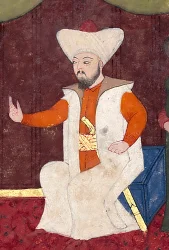
Gaius Marius
- An outsider enters Roman politics
- Victory over northern invaders
- Rivalry and civil war
- A legacy of military success and political rupture
Gaius Marius rose from outside Rome’s old ruling families to become one of the Republic’s most celebrated generals. His victories over Jugurtha, the Teutones, and the Cimbri made him consul seven times, an unprecedented achievement. In later life, however, his rivalry with Sulla helped turn political competition into civil war and exposed the Republic’s growing dependence on military power.
An outsider enters Roman politics
Marius was born around 157 BCE at Arpinum, a town south of Rome. His family was influential locally but did not belong to Rome’s hereditary elite. He built his reputation through military service, including the Numantine campaign in Spain, and gradually advanced through the Roman political system. His marriage to Julia, a member of the patrician Julii family, connected him to one of Rome’s oldest lineages.
In 107 BCE, Marius was elected consul and given command in the war against Jugurtha, king of Numidia. He recruited additional soldiers and campaigned in North Africa. The war’s conclusion owed much to his quaestor Lucius Cornelius Sulla, who negotiated with the Mauretanian king Bocchus, leading to Jugurtha’s capture. Marius received the principal credit in Rome, while Sulla later made sure his own part was remembered.
Victory over northern invaders
Rome then faced the migration of the Cimbri and Teutones, whose forces had defeated several Roman armies. Marius was elected consul repeatedly between 104 and 100 BCE, as the republic sought an experienced commander. He defeated the Teutones at Aquae Sextiae in 102 and the Cimbri at Vercellae in 101, victories that ended the immediate danger to Italy and made him a public hero.
Marius is often credited with remaking the Roman army by opening recruitment to citizens without property and creating a more professional force. The evidence for a single, sweeping reform is debated; changes in recruitment, equipment, and organization took place over time. His campaigns did increase the army’s importance in Roman public life, and soldiers increasingly looked to commanders to secure rewards and land after service.
Rivalry and civil war
After his string of consulships, Marius struggled to maintain the same political influence in Rome. In 88 BCE, a dispute over command in the war against Mithridates led the people to transfer the command from Sulla to Marius. Sulla responded by marching his legions on Rome, a shocking breach of republican norms. Marius fled the city, while Sulla took control and left for the East.
Marius returned in 87 with the consul Lucius Cornelius Cinna and seized Rome after a period of fighting. Their supporters carried out violent reprisals against opponents. In 86, Marius was elected consul for a seventh time, but he died only weeks after taking office, aged about seventy. Sulla later returned from the East and defeated Marius’s allies, becoming dictator and imposing a new political settlement.
A legacy of military success and political rupture
Marius’s career showed that command and popular support could elevate a man beyond the old aristocratic networks. His victories protected Rome at a critical moment, while his repeated consulships and military rivalry with Sulla helped strain the Republic’s rules. The collapse of the republic had many causes, but Marius’s life illustrates how personal armies, political ambition, and institutional conflict became increasingly difficult to separate.