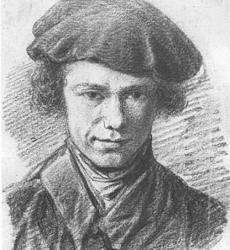
Ganna Shostak
 Ukraine
- Hanna Shostak: A Ukrainian Master of Decorative Painting
- Recognition and Acclaim
- Artistic Style and Innovation
- International Recognition and Exhibition
- Legacy and Impact
Hanna Shostak: A Ukrainian Master of Decorative Painting
Early Life and InfluencesGanna Sobachko, who later became known as Hanna Shostak, was born into a poor peasant family in the village of Skoptsy (now Veselinovka) near Kyiv. Her formal education was limited to two years, and she spent the rest of her childhood working in the fields for wealthy farmers. From an early age, she developed a deep love for flowers, finding solace in their beauty. Her childhood interest in painting blossomed into a profession, and in 1910, she met A.V. Semigradova, a patron of folk art, who provided her with a room to work as a studio and introduced her to other artists.
Under the influence of Evgenia Pribylskaya and Alexandra Exter, Shostak transitioned from traditional folk painting to decorative graphics. She experimented with watercolor and gouache, creating dynamic compositions characterized by asymmetrical shapes and whimsical floral motifs. Her vibrant use of color conveyed the joy and sadness of human emotions, the beauty of nature, and her love for her homeland and its people.
Recognition and Acclaim
In 1931, while working for the Kyiv Artel, Shostak won a republican competition for Ukrainian decorative painting. This led to her commission to design the Ukrainian pavilion at the All-Russian Agricultural Exhibition in Moscow (now the Exhibition of Achievements of the National Economy). Her work earned her recognition as a Master of Folk Art, and she was admitted to the Union of Artists of the USSR.
Artistic Style and Innovation
Shostak's art embraced both traditional Ukrainian motifs and modernist influences. Her compositions were characterized by their vibrant colors and playful, fluid designs. She created both large-scale installations and intimate works on paper, exploring themes of nature, folk culture, and the human experience. Her dynamic compositions and unconventional color schemes have become synonymous with her unique style.
International Recognition and Exhibition
Shostak's work gained international recognition through exhibitions in Berlin, Moscow, Dresden, Munich, and Kyiv. In 1913, carpets made according to her designs received a silver medal in St. Petersburg and a gold medal in Kyiv. Her art continues to be featured in museums in Kyiv and other cities, and her designs are reproduced on postcards and in art albums.
Legacy and Impact
Hanna Shostak passed away on December 3, 1965. Her artwork remains a testament to her talent and her unwavering love for Ukrainian folk art. She is celebrated as a Master of Folk Art of the Ukrainian SSR and a laureate of the Taras Shevchenko State Prize of Ukraine. Her artistic contributions have left a lasting legacy, inspiring countless contemporary artists and preserving the beauty and traditions of Ukrainian culture.