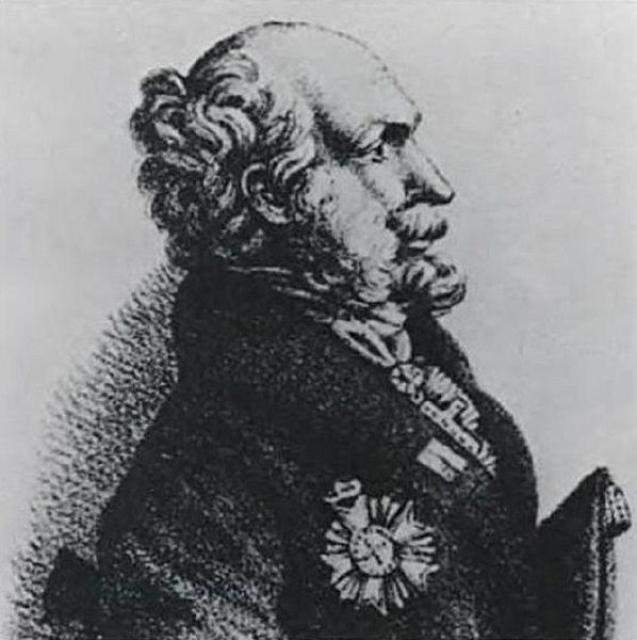
Georg Schaffer
 Brazil
- Georg Schäffer: A German Traveler, Naturalist, and Adventurer
- Participation in the Alaskan Expedition
- The Hawaiian Adventure
- Later Life and Legacy
Georg Schäffer: A German Traveler, Naturalist, and Adventurer
Georg Schäffer, a German traveler, naturalist, and adventurer, was born on January 7, 1779 in Münnerstadt, Franconia. After studying pharmacology in Würzburg, he received his doctorate in medicine in January 1808 and emigrated to Russia with his wife later that year. Initially serving as a military doctor in St. Petersburg, he moved to Moscow in 1812. Due to his achievements, he was granted the title of baron and was rumored to be a master of the Masonic Order.
Participation in the Alaskan Expedition
In 1813, Schäffer took part in a maritime expedition to Alaska on the military schooner "Suvorov." However, he was dismissed from the ship for being described as an "intolerable person on board."
The Hawaiian Adventure
In January 1815, the ship "Bering" of the Russian-American Company (purchased from the Americans, formerly known as "Atahuallpa") arrived in the harbor of Waimea on the island of Kauai for replenishing water and supplies. Unexpectedly, Governor Kaumuali'i of Kauai announced the confiscation of the ship and its cargo worth 100,000 rubles.
In response, the head of the Russian-American Company, A. A. Baranov, immediately sent an armed expedition on the ship "Otкрытие" to rescue them. Schäffer first arrived in Oahu, where he was warmly welcomed by King Kamehameha. Schäffer treated the royal family, but the king gradually became suspicious of his intentions. Schäffer headed to Kauai, prepared to forcefully retrieve the ship. However, no weapons were required as King Kaumuali'i was willing to return the ship and cargo. The king sought a powerful patron to maintain his independence from Kamehameha and decided to use Russia for this purpose. Schäffer's intentions aligned perfectly with his desire to take control of the island and use it as an intermediate port for the Russian-American Company's ships. Over the course of several months, Schäffer established Russian presence on Kauai and, as a result, received a royal gift — the Hanalei Valley in the north of the island, which he renamed Schäffertal, and the Hanapepe River, which he renamed Don.
Under Schäffer's leadership, three forts were built in 1816: Fort Elizabeth, Fort Alexander, and Fort Barclay. However, in March 1817, five ships with armed Americans and natives arrived at the island, destroying all Russian trading posts and plantations, and forcing Russian subjects to board one of the Russian ships and depart.
Later Life and Legacy
Upon his arrival in St. Petersburg, Schäffer presented the government with a plan for Russia to occupy one of the Hawaiian Islands. Although supported by the Russian-American Company, the project was rejected by the Tsar. In April 1818, Schäffer arrived in Brazil on the Portuguese ship "Luconia" from Macao via Australia and China. In Rio de Janeiro, he gained an audience with Princess Maria Leopoldina, the wife of future Emperor Pedro I of Brazil, and presented her with his rich botanical collection, which later became part of the Royal Museum's exhibition. He briefly returned to Europe to settle affairs and then came back to Brazil in 1821, founding the first German colony, Francontal, in the state of Bahia with four other families (20 people) on the land granted to him.
In September 1822, Schäffer was sent to Europe with a mission to recruit German soldiers and new settlers. This mission marked the beginning of mass German immigration to Brazil, which had recently declared its independence from Portugal. In July 1828, Schäffer returned to Brazil and appealed to the emperor for the title of Viscount Francontal Jacaranda, but was denied and only received financial compensation for his efforts in Europe. After some time, he returned to Europe again. In 1829, he unsuccessfully sought appointment as the Brazilian ambassador to Germany.
Georg Schäffer passed away in obscurity, presumably in 1836, in the colony he founded, Francontal.


